
FCA Cass7 Cass6 Client Money Audits
FCA CASS 7.13 Normal vs Alternative Approach Client Money Segregation Mechanics
Under FCA CASS 7.13, UK investment firms must segregate client cash directly upon receipt via the Normal Approach unless an external auditor certifies Alternative Approach eligibility backed by a 3-month rolling mandatory prudent buffer.
Direct receipt into a segregated statutory trust bank account under CASS 7.13.6R remains the baseline rule for over 94% of UK retail and institutional brokerage houses supervised by the Financial Conduct Authority, leaving the Alternative Approach under CASS 7.13.62R confined to wholesale multi-currency clearing banks and institutional prime dealers. Whenever a London firm inadvertently routes Faster Payments, CHAPS wires, or card acquirer settlements through a corporate operating IBAN without a formal Alternative Approach election and auditor sign-off, it commits an immediate CASS 7.13 commingling breach reportable in its annual assurance schedule. Within our FCA CASS 7 & CASS 6 master architecture guide, distinguishing permissible mixed-remittance clearing from unlawful house-account routing is the first line of supervisory defence.
Mechanics of the Normal Approach Under CASS 7.13.6R#
Under the Normal Approach, every client deposit—whether sterling settled across the Bank of England RTGS System or foreign currency settled via Nostro correspondents—must be paid directly by the client or payment service provider into a designated client bank account covered by an active acknowledgement letter. Firm house accounts never touch incoming principal.
Two narrow operational exceptions exist inside the Normal Approach:
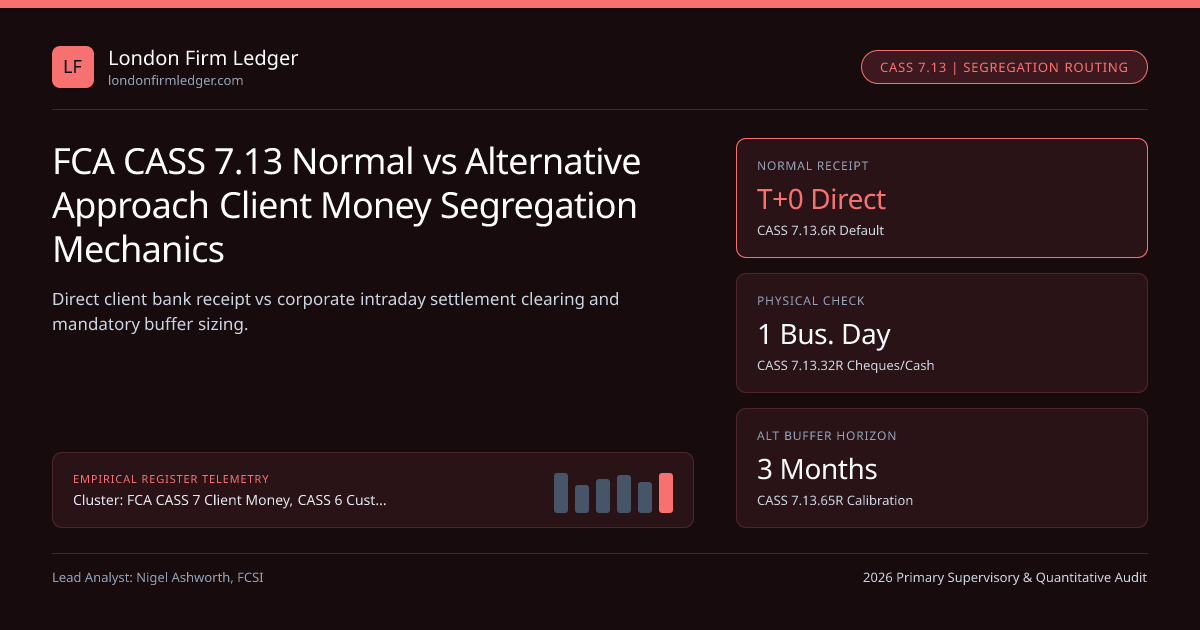
- Physical Receipts and Cheques (CASS 7.13.32R): Cash or cheques physically delivered to a branch or office must be paid into a client bank account no later than the business day following receipt (
T+1), while held securely in a locked physical ledger register overnight. - Mixed Remittances (CASS 7.13.31R) and Merchant Acquirer Settlement Pipelines: Where a retail CFD broker such as Capital Com or City Index collects debit-card deposits via an acquirer such as Adyen, the acquirer settlement IBAN itself must either be structured as a designated CASS 7.18 client transaction/bank account, or swept on receipt without corporate treasury diversion.
Qualifying Conditions for the Alternative Approach (CASS 7.13.62R)#
Wholesale FX prime brokers and multi-venue derivatives houses—comparable in operational profile to institutional liquidity desks tracked on the FCA CASS Topic Hub—sometimes execute thousands of bilateral CLS and LCH currency legs per minute where upstream settlement banks net corporate and client obligations across a single Nostro account. CASS 7.13.62R permits receiving client money into and paying client money out of the firm's own corporate bank accounts only if four cumulative statutory prerequisites are satisfied prior to go-live:
- Documented Operational Necessity: The board records written reasons demonstrating why Normal Approach segregation would create disproportionate settlement fail rates or currency cut-off risk across time zones.
- External Auditor Pre-Certification (CASS 7.13.63R): The firm's client-asset external auditor issues a written report confirming that internal ledger and IT controls are suitably designed to operate the Alternative Approach accurately.
- Advance FCA Notification: Written notice is lodged with the FCA supervisory team prior to commencing or extending Alternative Approach usage to a new business line.
- Mandatory Prudent Segregation Buffer (CASS 7.13.65R): Before day one, the firm deposits corporate cash into a segregated client bank account specifically recorded as an Alternative Approach Mandatory Prudent Segregation Buffer.
| Operational Dimension | Normal Approach (CASS 7.13.6R) | Alternative Approach (CASS 7.13.62R) | Supervisory Consequence of Misclassification |
|---|---|---|---|
| Initial Receipt Account | Designated CASS 7.18 Client Bank Account | Firm Own Corporate Clearing / Nostro Account | Unauthorised house receipt = immediate CASS 7.13 breach |
| Intraday Set-Off Risk | Shielded by bank acknowledgement waiver | Exposed to corporate bank lien until T+1 sweep | Triggers mandatory pre-funded prudent buffer |
| External Auditor Sign-Off | Annual SUP 3.10 assurance audit post-year-end | Pre-implementation CASS 7.13.63R written report | Operating without pre-audit triggers s166 review |
| Typical City Cohort | City Index, BUX, CPT Markets | Wholesale multi-CCY investment bank branches | Retail-only CFD brokers rarely pass necessity test |
| Daily Reconciliation Link | Verifies segregated cash matches ledger | Calculates net corporate-to-trust cash transfer | Late T+1 sweep requires SUP 15.3 FCA alert |
Calibrating the 3-Month Mandatory Prudent Segregation Buffer#
Why did the post-Lehman CASS rewrite introduce CASS 7.13.65R? When Lehman Brothers International (Europe) entered administration at 07:56 BST on 15 September 2008, hundreds of millions of dollars received under the old Alternative Approach remained trapped in unsegregated house accounts, triggering years of Supreme Court litigation (Lehman Brothers International (Europe) v CRC Credit Fund Ltd [2012] UKSC 6).
To prevent unsegregated intraday inflows from starving the client pool if an administration order strikes mid-afternoon, CASS 7.13.65R forces every Alternative Approach house to pre-fund a static buffer inside a segregated client bank account for the upcoming three-month window. That buffer must cover the high-watermark intraday net shortfall observed across historical business days over the preceding quarter, adjusted upward for seasonal volume surges such as FTSE quarterly expiry or sovereign gilt auction dates.
- DailyUnsegregatedPeak(d) = max{t in Intraday(d)} (ClientInflowsInHouseAcct(d,t) - ClientOutflowsFromHouse_Acct(d,t))
- BaseQuarterlyBuffer = P99orMax{d in Prior65BusinessDays} [ DailyUnsegregatedPeak(d) ]
- RequiredSegregatedBuffer = BaseQuarterlyBuffer * (1 + StressGrowthScalar)
- Worked Wholesale Multi-Currency Desk Calibration:
- Observed 65-Day Max Unsegregated Net Inflow (Quarterly IMM Roll Date) = GBP 18,400,000
- Board Approved Volume Expansion Scalar (Q1 Volatility Allowance) = 12.5% (0.125)
- RequiredSegregatedBuffer = GBP 18,400,000 * 1.125 = GBP 20,700,000
- Locked in Dedicated CASS 7.18 Buffer Account for Next 3 Calendar Months = GBP 20,700,000
Intraday Payment Acquirer Traps and Card Settlement Audits#
Retail trading platforms frequently stumble over pseudo-Alternative-Approach pipelines created by fintech payment gateways. Suppose a London brokerage listed under FCA Client Assets Sourcebook (CASS 7) integrates three card and open-banking PSPs. If PSP settlement batches land in an e-money merchant wallet lacking a countersigned CASS 7.18 statutory trust acknowledgement letter and are only swept to Barclays or NatWest client accounts on T+2, the firm is neither compliant with the Normal Approach (because funds sat outside a qualifying client bank account) nor protected by the Alternative Approach (because no CASS 7.13.63R auditor opinion exists).
Governance Controls When Transitioning Between Segregation Modes#
Firms migrating legacy institutional desks off the Alternative Approach onto real-time virtual-IBAN Normal Approach architectures must run parallel shadow reconciliations for at least 20 business days before releasing their CASS 7.13.65R buffer. Before releasing a single pound of corporate buffer cash, SMF18 compliance teams must verify that every client virtual IBAN maps deterministically to the parent client bank master account in the CASS 7.15 internal client money reconciliation and update Section 4 of the firm's CASS 10 Resolution Pack within five business days.
Frequently asked questions
When can an FCA regulated firm legally use the CASS 7.13 Alternative Approach?
Only when client transactions execute across complex multi-currency, high-frequency settlement environments where direct receipt into client bank accounts would cause severe operational settlement failures, and only after obtaining a written external auditor systems-adequacy opinion.
How quickly must mixed remittances be split under the Normal Approach in CASS 7.13.31R?
Where a client sends a combined wire covering both regulated investment margin and unregulated corporate invoice fees, the entire sum should initially enter the client bank account and the firm fee portion must be extracted promptly once reconciled, typically within T+1.
Does client money lose statutory trust status while sitting in a firm account under the Alternative Approach?
No. The CASS 7.17 statutory trust attaches on receipt, but commingling inside a corporate house account creates forensic tracing risk and exposes cash to bank set-off during intraday hours—which is why CASS 7.13.65R mandates pre-funded prudent segregation.
How often must the Alternative Approach Mandatory Prudent Segregation Buffer be recalculated?
Under CASS 7.13.65R, the firm must recalculate the buffer at least every three months based on actual peak net inflows held in corporate accounts over the prior quarter, locking the Segregated Buffer in a dedicated client bank account.
Publication record
- Published
- 14 November 2026
- Updated
- 14 November 2026
- Author
- Nigel Ashworth, FCSI
- Review
- Review not recorded
- Automated fact check
- Passed in the stored pipeline record
- Source URLs
- 3 recorded
AI assistance recorded: anthropic/claude-opus-4.6. This field does not establish human review or source verification.
Academic & Institutional Attribution
Cite This Research & Embed Live Data Card
Standard academic & institutional research paper citation format.
Nigel Ashworth, FCSI. (2026, November 14). FCA CASS 7.13 Normal vs Alternative Approach Client Money Segregation Mechanics. London Firm Ledger. https://londonfirmledger.com/gazette/cass-7-13-normal-vs-alternative-approach-reconciliation-mechanicsRegulatory Directory Cross-Reference
Referenced Institutions & Regulatory Registries
Mentioned Regulated Institutions
Referenced Supervisory Authorities
Related FCA Cass7 Cass6 Client Money Audits & Institutional Briefings
Explore FCA Cass7 Cass6 Client Money Audits Hub (20) →FCA Cass7 Cass6 Client Money Audits
FCA CASS 7 Client Money, CASS 6 Custody, CMAR & Resolution Pack Architecture (2026)FCA Cass7 Cass6 Client Money Audits
FCA CASS 7.15 Daily Internal Client Money Reconciliation & Top-Up CalculationFCA Cass7 Cass6 Client Money Audits
FCA CASS 7.15.20R External Client Money Reconciliations & Break Aging ControlsFCA Cass7 Cass6 Client Money Audits
FCA CASS 7.18 Trust Acknowledgement Letters & 20-Business-Day RuleFCA Cass7 Cass6 Client Money Audits
FCA CASS 7.13 Client Bank Diversification, 20% Group Cap & 95-Day Term RuleFCA Cass7 Cass6 Client Money Audits
FCA CASS 7.11 Title Transfer Collateral Arrangements (TTCA) & Retail BanFCA Cass7 Cass6 Client Money Audits
FCA CASS 7.11.14R Delivery-versus-Payment (DvP) Settlement Window & T+3 CapFCA Cass7 Cass6 Client Money Audits
FCA CASS 7.14 Client Transaction Accounts, CCP Margining & ISA PortingUK Ifpr Mifidprul Icap Kfactors
FCA MIFIDPRU 4.5 Fixed Overheads Requirement: Deductions & 30% Change TriggersUK Ifpr Mifidprul Icap Kfactors
FCA MIFIDPRU 1.2 Small and Non-Interconnected (SNI) Firm Threshold TestsUK Ifpr Mifidprul Icap Kfactors
FCA MIFIDPRU 3 Own Funds Composition: 56% CET1, AT1 & Tier 2 Gearing RulesUK Ifpr Mifidprul Icap Kfactors
FCA MIFIDPRU 4.7–4.9 Client K-Factors: K-AUM, K-CMH & K-ASA Calibration
London Firm Ledger Data, Benchmarks & Contributor Records
CC BY 4.0 Open Data
Open Institutional Datasets (CSV / JSON) →
Download desk-compiled quantitative series & schemas.
2026 Reference Matrix
2026 Institutional Benchmarks & Thresholds →
Statutory capital, clearing, margin & rate conventions.
Editorial Records
Authors & Review Records →
View named contributors where those records are available.
Complete Index
Master Research & Dossier Archive →
Browse all published briefings by topic pillar & date.