
FCA Cass7 Cass6 Client Money Audits
FCA CASS 7.13 Client Bank Diversification, 20% Group Cap & 95-Day Term Rule
FCA CASS 7.13 caps intra-group bank placements of client money at 20% of total segregated funds, bans unbreakable fixed-term deposits, restricts notice accounts to 95 days, and requires documented bank credit due diligence.
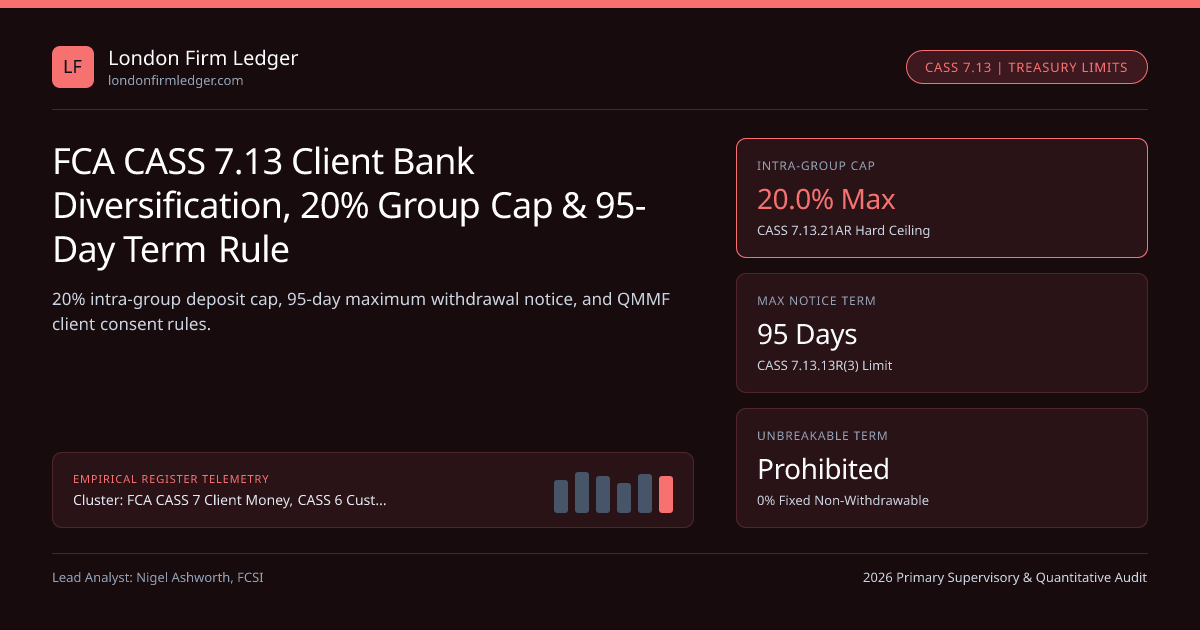
Concentration of segregated client balances inside a single banking group—or locking client cash into illiquid yield-enhancing term deposits—poses acute systemic contagion risk supervised closely by the Financial Conduct Authority. Under CASS 7.13.20R through 7.13.25R, every City of London investment firm must actively diversify client bank placements, enforce a hard 20% ceiling on intra-group credit institutions, and outlaw unbreakable fixed-term accounts. Across our FCA CASS 7 & CASS 6 master architecture guide, treasury yield optimisation on client cash is strictly subordinate to immediate insolvency distributability and Consumer Duty fair-value scrutiny.
The 20% Intra-Group Credit Institution Ceiling (CASS 7.13.21AR)#
When a brokerage subsidiary of a banking group—such as a wealth or capital-markets arm affiliated with Barclays, HSBC, Lloyds, or NatWest—deposits client money with its parent or sister bank, correlated default risk arises: the exact macroeconomic shock that topples the brokerage could simultaneously trigger resolution at the parent bank.
To sever contagious failure loops, CASS 7.13.21AR mandates that at the point of each daily CASS 7.15 internal client money reconciliation, the aggregate balance held across all group credit institutions must not exceed 20% of the firm's total client money resource held across all CASS 7.13 bank accounts and QMMFs. Only micro-balance firms passing the strict proportionality test in CASS 7.13.21CR (and filing formal FCA notifications) can exceed 20%.

Prohibition on Unbreakable Deposits and the 95-Day Notice Regime#
During the higher sterling interest-rate cycle, FCA thematic reviews uncovered retail platforms locking up 60%–80% of client cash inside 6-month and 12-month treasury deposits to harvest net interest margin while paying clients minimal pass-through yield. CASS 7.13.13R imposes three hard structural walls:
- Zero Unbreakable Term Deposits: Client money may never be placed in an account where principal cannot be withdrawn prior to maturity—even if early breakage forfeits accrued interest.
- Maximum 95-Day Notice or Breakable Term: Any client bank account requiring prior withdrawal notice, or permitting withdrawal within a contractual window up to 95 calendar days, is restricted by CASS 7.13.13R(3).
- 31-to-95-Day Enhanced Governance (CASS 7.13.14BR–14ER): Before placing client money into accounts with withdrawal periods between 31 and 95 days, the firm must adopt a written liquidity-risk policy, run stress redemptions against historical peak withdrawal velocity, and provide clear written pre-disclosure warning clients that funds held in 31–95 day accounts could experience delayed distribution during a CASS 7.17 secondary pooling event.
Permitted Tenor and Notice-Account Comparison Matrix#
| Placement Vehicle | Maximum Permitted Tenor | CASS Rule Anchor | Client Disclosure & Consent Requirement | Typical City Usage Profile |
|---|---|---|---|---|
| Instant-Access Client Call Account | Overnight / Same-Day CHAPS | CASS 7.13.3R | Standard terms + CASS 7.18 Annex 2R letter | Minimum 40%–65% core settlement liquidity (City Index, BUX) |
| Up to 30-Day Notice Trust Account | 1 to 30 Calendar Days | CASS 7.13.13R(2) | Included in CASS liquidity ladder monitoring | Core treasury tier matching Basel LCR 30-day bucket |
| 31-to-95-Day Notice / Breakable Term | 31 to 95 Calendar Days | CASS 7.13.13R(3) + 7.13.14CR | Mandatory written client delay risk disclosure | Capped at 15%–30% of sticky ISA/SIPP cash balances |
| Unbreakable Fixed Deposit (>0 Days) | Strictly Prohibited | CASS 7.13.13R | Cannot be cured by client consent (retail/wholesale) | Zero permitted allocation across all FCA CASS firms |
| Qualifying Money Market Fund (QMMF) | Daily-Dealing AAA CNAV/LVNAV | CASS 7.13.26R | Explicit advance notice + right to opt out | Institutional & multi-currency houses (Britannia, Alpha FX) |
Quantitative Treasury Stress Model: Withdrawal Velocity vs 95-Day Buckets#
How much client cash can a London multi-asset house safely allocate to 35-day and 95-day notice accounts without risking settlement paralysis during a market sell-off similar to March 2020 or the September 2022 UK gilt LDI shock?
- InstantAccessShare (S0) >= Peak5DayOutflowPct + PeakCCPMarginDrainPct + Safety_Haircut
- Bucket30dShare (S30) <= 1 - S0 - S_95
- GroupBankShare (G_b) <= 0.20 (Hard Statutory Cap; Internal Desk Limit = 0.175)
- Worked GBP 400,000,000 Client Money Pool Allocation:
- Historical 99.5th Percentile 5-Day Client Withdrawal Rate = 18.5% (GBP 74,000,000)
- Peak Intraday/5-Day CCP Client Margin Transfer Demand = 14.0% (GBP 56,000,000)
- Board Prudent Liquidity Buffer = 12.5% (GBP 50,000,000)
- Minimum Instant-Access Call Allocation (S_0) = 45.0% (GBP 180,000,000 across 3 external Tier-1 banks)
- 30-Day Notice Allocation (S_30) = 35.0% (GBP 140,000,000; includes GBP 68,000,000 [17.0%] at Group Bank)
- 60/95-Day Notice Allocation (S_95) = 20.0% (GBP 80,000,000 with CASS 7.13.14ER client risk disclosure)
Third-Party Bank Due Diligence and FSCS Brand-Sharing Disclosures#
Under CASS 7.13.8R, selecting non-affiliated banks still requires formal credit committee scorecards evaluating Common Equity Tier 1 (CET1) ratios, Moody's/S&P/Fitch short-term deposit ratings, sovereign CDS spreads, and jurisdiction insolvency priority. Furthermore, where a firm spreads client cash across two banking brands that share a single PRA banking authorisation (for instance, Halifax and Bank of Scotland under one FRN), retail clients receive only a single combined GBP 85,000 FSCS look-through shield—making accurate bank-name disclosure in client statements critical for both CASS 7.13 and Consumer Duty compliance.
Frequently asked questions
Can a small UK brokerage qualify for an exemption from the 20% intra-group bank cap under CASS 7.13.21CR?
Only if the firm demonstrates through an annual written assessment—notified to the FCA via RegData—that complying with the 20% intra-group limit would be disproportionate given its tiny client money balance, business model, and third-party banking minimums.
Why did the FCA ban unbreakable fixed-term deposits for client money in 2018?
Unbreakable fixed-term deposits prevented Special Administrators from returning client cash promptly upon broker insolvency and created liquidity mismatches with PRA Liquidity Coverage Ratio (LCR) 30-day outflow assumptions, leading the FCA to cap withdrawal periods at 95 days.
How often must a firm review the creditworthiness and diversification of third-party client banks?
CASS 7.13.8R and 7.13.20R require periodic due diligence—at minimum annually and immediately upon rating downgrades or CDS spread spikes—assessing capital ratios, sovereign domicile, bail-in rank, and FSCS look-through overlap.
How are Qualifying Money Market Fund (QMMF) holdings treated differently from client bank deposits?
When client cash is invested into a daily-dealing low-volatility net asset value (LVNAV) or public-debt CNAV QMMF under CASS 7.13.26R, the resulting fund units are safeguarded as safe custody investments under CASS 6 rather than bank liabilities.
Publication record
- Published
- 14 November 2026
- Updated
- 15 November 2026
- Author
- Nigel Ashworth, FCSI
- Review
- Review not recorded
- Automated fact check
- Passed in the stored pipeline record
- Source URLs
- 3 recorded
AI assistance recorded: anthropic/claude-opus-4.6. This field does not establish human review or source verification.
Academic & Institutional Attribution
Cite This Research & Embed Live Data Card
Standard academic & institutional research paper citation format.
Nigel Ashworth, FCSI. (2026, November 15). FCA CASS 7.13 Client Bank Diversification, 20% Group Cap & 95-Day Term Rule. London Firm Ledger. https://londonfirmledger.com/gazette/cass-7-13-diversification-credit-institution-group-20-percent-capRegulatory Directory Cross-Reference
Referenced Institutions & Regulatory Registries
Mentioned Regulated Institutions
Referenced Supervisory Authorities
Related FCA Cass7 Cass6 Client Money Audits & Institutional Briefings
Explore FCA Cass7 Cass6 Client Money Audits Hub (20) →FCA Cass7 Cass6 Client Money Audits
FCA CASS 7 Client Money, CASS 6 Custody, CMAR & Resolution Pack Architecture (2026)FCA Cass7 Cass6 Client Money Audits
FCA CASS 7.11 Title Transfer Collateral Arrangements (TTCA) & Retail BanFCA Cass7 Cass6 Client Money Audits
FCA CASS 7.11.14R Delivery-versus-Payment (DvP) Settlement Window & T+3 CapFCA Cass7 Cass6 Client Money Audits
FCA CASS 7.14 Client Transaction Accounts, CCP Margining & ISA PortingFCA Cass7 Cass6 Client Money Audits
FCA CASS 7.17 Statutory Trust & CASS 7A Primary vs Secondary Pooling EventsFCA Cass7 Cass6 Client Money Audits
FCA CASS 6.2 Safe Custody Asset Registration, CREST & Nominee GovernanceFCA Cass7 Cass6 Client Money Audits
FCA CASS 6.4 Prime Brokerage Right-to-Use, Rehypothecation Caps & CASS 9.3FCA Cass7 Cass6 Client Money Audits
FCA CASS 6.6 Custody Reconciliations, Rolling Stock Counts & Shortfall CoverUK Ifpr Mifidprul Icap Kfactors
FCA MIFIDPRU 4.10 & 4.15 Throughput K-Factors: K-COH vs K-DTF MechanicsUK Ifpr Mifidprul Icap Kfactors
FCA MIFIDPRU 4.11–4.13 Market Risk: K-NPR CRR Ladders vs K-CMG × 1.3 ClearingUK Ifpr Mifidprul Icap Kfactors
FCA MIFIDPRU 4.14 Trading Counterparty Default (K-TCD): SA-CCR, RF & CVAUK Ifpr Mifidprul Icap Kfactors
FCA MIFIDPRU 5 Concentration Risk (K-CON): 25% Soft Limit & 200%–900% Multipliers
London Firm Ledger Data, Benchmarks & Contributor Records
CC BY 4.0 Open Data
Open Institutional Datasets (CSV / JSON) →
Download desk-compiled quantitative series & schemas.
2026 Reference Matrix
2026 Institutional Benchmarks & Thresholds →
Statutory capital, clearing, margin & rate conventions.
Editorial Records
Authors & Review Records →
View named contributors where those records are available.
Complete Index
Master Research & Dossier Archive →
Browse all published briefings by topic pillar & date.