
FCA Cass7 Cass6 Client Money Audits
FCA CASS 7.15.20R External Client Money Reconciliations & Break Aging Controls
Under FCA CASS 7.15.20R, UK investment firms must reconcile internal client cashbooks against external bank and CCP statements at least monthly—and daily for high-frequency cash accounts—escalating aged breaks via CMAR.
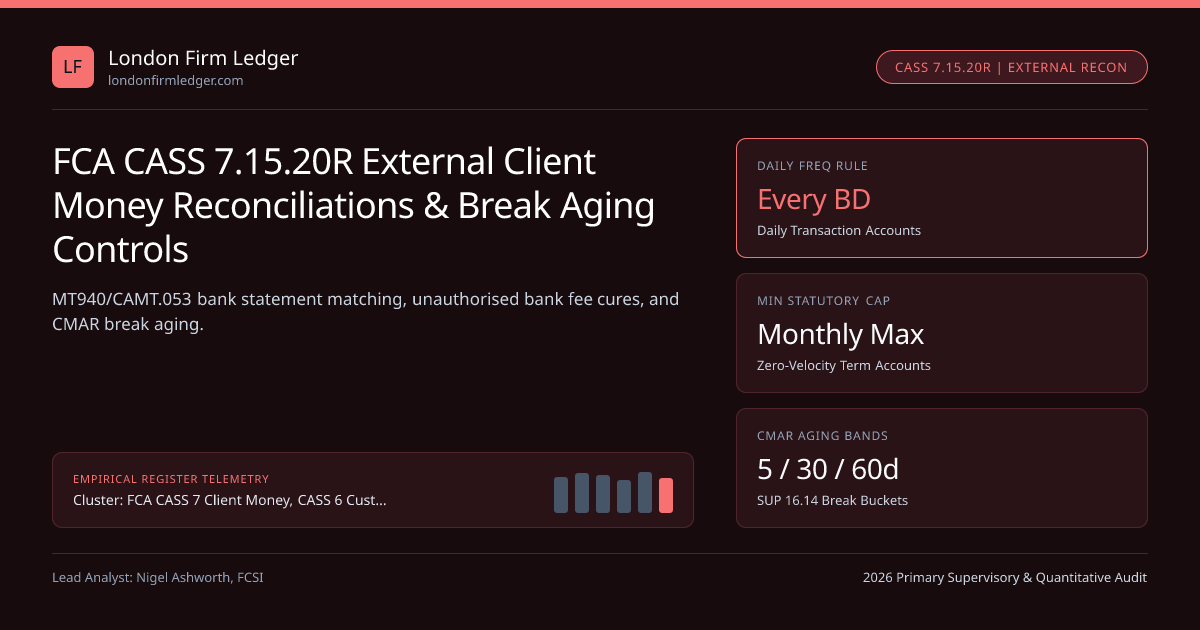
Internal cashbook accuracy means nothing in an insolvency if the physical credit institution statement at Barclays, NatWest, or HSBC holds GBP 2.4 million less than the broker's general ledger claims. Under CASS 7.15.20R, every firm regulated by the Financial Conduct Authority must perform an independent External Client Money Reconciliation comparing its internal client bank ledgers against statements supplied directly by third-party banks, exchanges, clearing houses, and qualifying money market funds. Across our FCA CASS 7 & CASS 6 master architecture guide, external reconciliation break aging represents the sharpest operational-control indicator tracked by FCA client-asset supervisors.
Frequency Calibration Across Instant-Access, Notice, and CCP Accounts#
CASS 7.15.22R prohibits gaps exceeding one calendar month between consecutive external reconciliations on any single client cash account, while CASS 7.15.23G links required cadence directly to transaction velocity:
- Daily Movement Client Bank & CCP Accounts: Reconciled every business day (
T+1) via automated SWIFT MT940 or ISO 20022 CAMT.053 statement ingestion across automated matching engines (such as AutoRek, Gresham, or Duco). - Weekly / Rolling Notice Accounts (up to 30-day notice): Reconciled at every interest capitalisation or rollover event and at minimum weekly across mid-tier City houses.
- Static Term Deposits (up to 95-day maximum CASS 7.13.13R cap): Reconciled at least monthly against authenticated bank confirmation portals, never relying solely on original deal tickets.
Crucially, under FCA / PRA Operational Resilience Policy (PS21/3), if a bank host-to-host SFTP channel fails on a Tuesday morning, CASS teams cannot postpone the reconciliation indefinitely; manual authenticated PDF/CSV portal downloads must execute within documented contingency windows before breaching CASS 7.15.33R notification triggers.
Anatomy of High-Risk Discrepancies and Bank Fee Deductions#
Not all external differences carry symmetric client harm. CASS 7.15.27R obliges the firm to investigate every discrepancy promptly and take corrective action without delay:
| External Discrepancy Type | Statement vs Cashbook Sign | Risk to Statutory Trust Pool | Required CASS 7.15.27R Remediation Action |
|---|---|---|---|
| Bank Maintenance / CHAPS Charge | Bank Statement < Firm Cashbook | Direct erosion of client pool; violates CASS 7.18 trust waiver | Inject corporate cash immediately; instruct bank to re-point fee billing to house IBAN |
| Unrecorded Client Direct Wire | Bank Statement > Firm Cashbook | Unallocated client receipt risk | Post to unallocated client money ledger; include in CASS 7.15 internal requirement |
| Returned / Recalled Client Payout | Bank Statement > Firm Cashbook | Beneficiaries under-credited on sub-ledger | Verify AML/sanctions return code; re-credit client ledger or hold in segregated suspense |
| Cashbook Duplicate Receipt Entry | Bank Statement < Firm Cashbook | Severe physical shortfall in bank account | Reverse phantom cashbook entry immediately; cover any resulting deficit on T+1 |
| CCP Intraday Margin Interest Debit | CCP Statement < Firm Cashbook | Clearing CTA underfunded at LCH / ICE | Reconcile interest statement daily; fund negative SONIA/ESTR interest from firm cash |
Quantitative Safe Surplus Withdrawal Guardrail Model#
Across London brokerages tracked on the FCA CASS Topic Hub—including multi-currency houses such as Amana Capital, City Credit Capital, and Capital Index—unauthorised correspondent bank lifting fees on USD and EUR incoming wires remain the single most frequent source of micro-deficits. Even a USD 25 intermediary SWIFT deduction charged to a segregated client account rather than a separate corporate fee account leaves physical bank funds below internal cashbook records unless reimbursed.
- RawInternalSurplusT = InternalCashbookResourceT - InternalClientRequirement_T
- AdverseExternalBreaksT = Sum{j} max(0, InternalCashbookBalj(T) - ExternalBankStatementBalj(T) - VerifiedT0InTransitDeposits_j)
- PermissibleCorporateSweep = max(0, RawInternalSurplusT - AdverseExternalBreaksT)
- Worked Treasury Guardrail Calculation:
- InternalCashbookResource_T = GBP 62,850,000
- InternalClientRequirement_T = GBP 62,400,000
- RawInternalSurplus_T = +GBP 450,000
- AdverseExternalBreaks_T = GBP 510,000 (rejected card acquirer settlement batch still posted in cashbook)
- PermissibleCorporateSweep = max(0, 450,000 - 510,000) = GBP 0
- Net Prudential Action = Freeze corporate sweep AND inject GBP 60,000 corporate cash cover pending acquirer re-settlement
Break Aging Governance and Monthly CMAR Supervisory Triggers#
When compiling the monthly SUP 16.14 CMAR return, CASS Medium and CASS Large firms must report exact counts and sterling values of unresolved external reconciliation breaks stratified by age bands (1–5 business days, 6–29 days, 30–59 days, and 60+ days).
Audit Trail Integrity and Stale-Item Roll-Forward Prevention#
During annual assurance fieldwork under the FRC standard, external auditors re-perform at least two random intra-year external reconciliations plus the period-end reconciliation. Two control defects routinely trigger qualified opinions under FRC Client Asset Assurance audits: first, "rolling forward" an aged break by deleting and re-booking the journal entry to reset its creation timestamp below 30 days; second, relying on spreadsheet exports without immutable maker-checker timestamps proving the reconciliation actually ran on T+1 rather than retroactively at month-end.
Frequently asked questions
How frequently must an active UK brokerage run CASS 7.15.20R external reconciliations?
While CASS 7.15.22R sets an absolute statutory outer limit of one month (for completely static fixed-term trust deposits), CASS 7.15.23G specifies that accounts with daily cash movements should be reconciled every business day on T+1.
What is the difference between a legitimate timing difference and a reportable CASS 7.15.27R discrepancy?
A settlement wire initiated at 16:45 on T that settles on the bank CAMT.053 statement on T+1 is a normal timing item if cleared on schedule; an unexpected bank fee debit, rejected payment, or stale T+3 unmatched item is a discrepancy requiring active remediation.
Can an automated reconciliation tool auto-match opposing debit and credit breaks without reference IDs?
No. FRC Client Asset Assurance auditors flag amount-only auto-matching rules that net unrelated incoming and outgoing breaks of identical value without verifying unique end-to-end payment references (UETR), as this masks underlying client misallocations.
When does an external reconciliation failure require immediate SUP 15 / CASS 7.15.33R notification to the FCA?
Immediate FCA notification is mandatory if SFTP or SWIFT feed outages prevent the firm from performing external reconciliations within its documented policy frequency, or if firm records are materially out of sync and cannot be promptly corrected.
Publication record
- Published
- 14 November 2026
- Updated
- 15 November 2026
- Author
- Nigel Ashworth, FCSI
- Review
- Review not recorded
- Automated fact check
- Passed in the stored pipeline record
- Source URLs
- 3 recorded
AI assistance recorded: anthropic/claude-opus-4.6. This field does not establish human review or source verification.
Academic & Institutional Attribution
Cite This Research & Embed Live Data Card
Standard academic & institutional research paper citation format.
Nigel Ashworth, FCSI. (2026, November 15). FCA CASS 7.15.20R External Client Money Reconciliations & Break Aging Controls. London Firm Ledger. https://londonfirmledger.com/gazette/cass-7-15-20r-external-bank-statement-reconciliation-break-agingRegulatory Directory Cross-Reference
Referenced Institutions & Regulatory Registries
Mentioned Regulated Institutions
Referenced Supervisory Authorities
Related FCA Cass7 Cass6 Client Money Audits & Institutional Briefings
Explore FCA Cass7 Cass6 Client Money Audits Hub (20) →FCA Cass7 Cass6 Client Money Audits
FCA CASS 7 Client Money, CASS 6 Custody, CMAR & Resolution Pack Architecture (2026)FCA Cass7 Cass6 Client Money Audits
FCA CASS 7.18 Trust Acknowledgement Letters & 20-Business-Day RuleFCA Cass7 Cass6 Client Money Audits
FCA CASS 7.13 Client Bank Diversification, 20% Group Cap & 95-Day Term RuleFCA Cass7 Cass6 Client Money Audits
FCA CASS 7.11 Title Transfer Collateral Arrangements (TTCA) & Retail BanFCA Cass7 Cass6 Client Money Audits
FCA CASS 7.11.14R Delivery-versus-Payment (DvP) Settlement Window & T+3 CapFCA Cass7 Cass6 Client Money Audits
FCA CASS 7.14 Client Transaction Accounts, CCP Margining & ISA PortingFCA Cass7 Cass6 Client Money Audits
FCA CASS 7.17 Statutory Trust & CASS 7A Primary vs Secondary Pooling EventsFCA Cass7 Cass6 Client Money Audits
FCA CASS 6.2 Safe Custody Asset Registration, CREST & Nominee GovernanceUK Ifpr Mifidprul Icap Kfactors
FCA MIFIDPRU 3 Own Funds Composition: 56% CET1, AT1 & Tier 2 Gearing RulesUK Ifpr Mifidprul Icap Kfactors
FCA MIFIDPRU 4.7–4.9 Client K-Factors: K-AUM, K-CMH & K-ASA CalibrationUK Ifpr Mifidprul Icap Kfactors
FCA MIFIDPRU 4.10 & 4.15 Throughput K-Factors: K-COH vs K-DTF MechanicsUK Ifpr Mifidprul Icap Kfactors
FCA MIFIDPRU 4.11–4.13 Market Risk: K-NPR CRR Ladders vs K-CMG × 1.3 Clearing
London Firm Ledger Data, Benchmarks & Contributor Records
CC BY 4.0 Open Data
Open Institutional Datasets (CSV / JSON) →
Download desk-compiled quantitative series & schemas.
2026 Reference Matrix
2026 Institutional Benchmarks & Thresholds →
Statutory capital, clearing, margin & rate conventions.
Editorial Records
Authors & Review Records →
View named contributors where those records are available.
Complete Index
Master Research & Dossier Archive →
Browse all published briefings by topic pillar & date.