
FCA Cass7 Cass6 Client Money Audits
FCA CASS 7.15 Daily Internal Client Money Reconciliation & Top-Up Calculation
FCA CASS 7.15 mandates business-day internal client money reconciliations comparing segregated ledger resources against gross client entitlements, prohibiting negative balance netting and requiring same-day corporate cash top-ups.
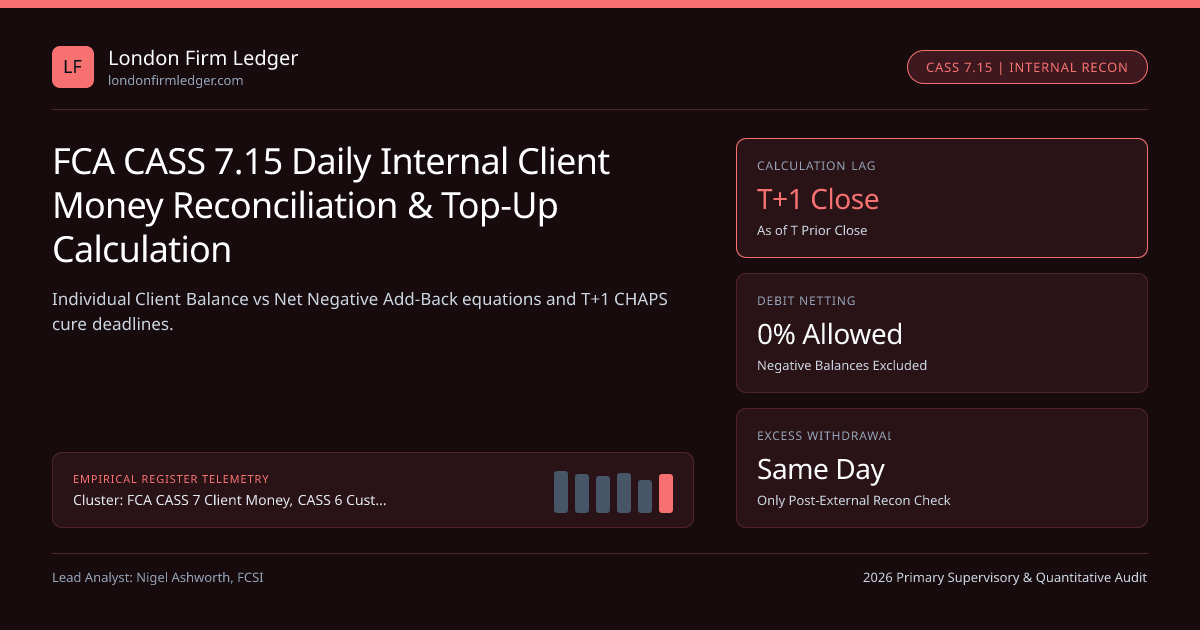
Every business afternoon across the City of London, CASS operations teams must prove to the penny that segregated cashbook resources equal or exceed the sum of every positive client entitlement as at the prior evening's close (23:59:59 UK time or venue settlement cut-off) under CASS 7.15.12R. Unlike bank liquidity ratios that tolerate statistical buffers, the Financial Conduct Authority treats even a single-day failure to cure an internal reconciliation shortfall before CHAPS close on T+1 as a reportable statutory breach under CASS 7.15.33R. Within our FCA CASS 7 & CASS 6 master architecture guide, CASS 7.15 is the mathematical core that protects positive-balance clients from subsidising fellow clients whose accounts fall into debit.
Client Money Resource vs Client Money Requirement Precision#
A recurring root cause of FCA Section 166 skilled-person mandates is substituting live online bank balances for internal cashbook ledgers when computing the Client Money Resource. Under CASS 7.15.16R, the Resource side of the internal reconciliation must strictly reflect the firm's own internal accounting records of balances held across CASS 7.18 client bank accounts and CASS 7.14 client transaction accounts at close of business T—never raw third-party bank statements (which belong to the separate CASS 7.15.20R external reconciliation).
Why does UK CASS 7 Client Money Rules insist on internal cashbooks? Suppose a client submits a GBP 500,000 withdrawal instruction at 16:50 on Tuesday (T): the firm reduces the client's sub-ledger immediately and posts an outbound credit entry on its internal client bank cashbook, even though the payment clears externally on Wednesday morning (T+1). Comparing a post-withdrawal client sub-ledger against a pre-withdrawal external bank statement would fabricate a phantom GBP 500,000 surplus, tempting treasury staff to sweep away GBP 500,000 of real client money!
Standard Methods: Individual Client Balance vs Net Negative Add-Back#
CASS 7 Annex 1 prescribes two permissible standard calculation routes that must produce mathematically identical results:
- Individual Client Balance Method: Iterates through every individual client record
i, computes net entitlement across sub-accounts only where the firm holds an enforceable right of cross-account set-off with that same legal client, floors any negative client total at zero, and sums all positive balances plus unallocated client cash receipts and prudent buffers. - Net Negative Add-Back Method: Starts from the general-ledger control account total of all client balances (positive and negative netted together) and adds back the absolute value of every individual client in net debit.
Multi-Currency Cashbook Adjustments and Ledger Component Rules#
Multi-currency brokers such as City Index, CFI International Ltd, and CPT Markets holding USD, EUR, JPY, and GBP client sub-accounts must convert non-sterling requirements and resources at the prior business day's closing spot rates under CASS 7.15.19R—or execute currency-by-currency reconciliations to eliminate overnight FX translation drift between USD liabilities and GBP bank deposits.
| Reconciliation Component | Treatment in Client Money Requirement | Impact on Corporate Own Funds | Common Audit Defect Seen on FCA Topic Hub |
|---|---|---|---|
| Positive Cash & Realised P&L | Included 100% (Bal_i > 0) | Segregated in CASS 7.18 accounts | Late trade-date vs settlement-date posting mismatch |
| Open CFD Net Unrealised Profit | Included in equity (CASS 7 Annex 1G) | Firm pre-funds winning MTM daily | Using mid-price for resource vs bid/ask for client equity |
| Negative Client Equity / Margin Deficit | Floored at GBP 0.00 (never netted) | Firm absorbs debit via own cash | Illegal cross-netting between retail ISA and CFD accounts |
| Unidentified Bank Inflows | Added to Requirement until proven corporate | Protected as client cash during probe | Parking unknown wires in corporate suspense > 48 hours |
| Uncleared Outbound Client Cheques | Retained in Requirement until cleared | Remains in segregated bank account | Deducting cheque on print date before bank presentation |
Worked Quantitative Stress Scenario: Flash-Gap Debit Spike#
Consider a London retail and professional CFD house modelled on peers in our City Index vs ITI Capital comparison after an overnight Swiss franc or gilt market gap pushes 42 leveraged professional accounts into negative equity while lifting 1,800 short accounts into sharp unrealised profit:
- General Ledger Net Control Total (All 1,842 Clients) = GBP 84,120,000
- Total Debit Balances Across 42 Deficit Clients = -GBP 3,640,000
- Gross Positive Client Balances (1,800 Clients) = GBP 87,760,000
- Check Equivalence:
- NetNegativeAdd_Back = GBP 84,120,000 + |-GBP 3,640,000| = GBP 87,760,000 (Exact Match)
- Add Unallocated Incoming Wires = GBP 195,000
- Add CASS 7.13.41R Prudent Buffer = GBP 750,000
- Total Client Money Requirement (T) = GBP 88,705,000
- Internal Cashbook Segregated Resource (T) = GBP 85,290,000
- Required T+1 Corporate Own-Funds Injection = GBP 88,705,000 - GBP 85,290,000 = GBP 3,415,000
Notice the acute liquidity interaction with MIFIDPRU: the firm must inject GBP 3,415,000 of unencumbered corporate cash into its client bank accounts before close of business on T+1, even if those 42 professional clients take five days to wire margin calls—directly linking CASS 7.15 shocks to ICARA liquid asset stress testing.
Surplus Withdrawal Guardrails and Non-Standard Method Approvals#
When Resource_T > Requirement_T, CASS 7.15.29R(2) generally instructs the firm to withdraw the excess corporate cash on T+1 so corporate money does not taint the statutory trust pool via unlawful commingling. However, treasury teams must never blindly sweep an apparent surplus without cross-checking the CASS 7.15.20R external bank reconciliation: if an external bank statement shows GBP 400,000 less cash than the internal cashbook due to a bounced incoming wire, sweeping a GBP 300,000 internal surplus leaves the physical bank account GBP 100,000 underwater. Finally, any firm seeking to use a Non-Standard Reconciliation Method under CASS 7.15.17R must first obtain a written external auditor report confirming that the custom algorithm never under-segregates relative to Annex 1 benchmarks, alongside updating its SUP 16.14 monthly CMAR telemetry.
Frequently asked questions
Why does CASS 7.15 use firm internal bank ledgers rather than external bank statements for Client Money Resource?
CASS 7.15.16R intentionally anchors Client Money Resource to the firm internal cashbook ledgers as at close of T so timing items—such as late-night CHAPS batches or uncleared wires—are evaluated on a consistent accounting cut-off against client sub-ledgers.
What is the difference between the Individual Client Balance method and the Net Negative Add-Back method?
Both yield identical statutory requirements under CASS 7 Annex 1: the Individual Client Balance method sums all positive client equity/cash balances directly, whereas the Net Negative Add-Back method starts from net ledger control totals and adds back every client account in debit.
How are open leveraged CFD or spread-betting unrealised profits treated in the CASS 7.15 requirement?
For retail and professional margined derivatives under CASS 7 Annex 1G, a client individual balance equals free cash plus initial/variation margin plus net unrealised profits (or minus unrealised losses), floored at zero per client across legally nettable sub-accounts.
What happens if a CHAPS cut-off failure prevents a firm from funding a CASS 7.15 shortfall on T+1?
Failure to segregate the required top-up by close of business on the reconciliation day violates CASS 7.15.29R and triggers an immediate mandatory notification to the FCA under CASS 7.15.33R, plus inclusion in the annual FRC assurance Breaches Schedule.
Publication record
- Published
- 14 November 2026
- Updated
- 14 November 2026
- Author
- Nigel Ashworth, FCSI
- Review
- Review not recorded
- Automated fact check
- Passed in the stored pipeline record
- Source URLs
- 3 recorded
AI assistance recorded: anthropic/claude-opus-4.6. This field does not establish human review or source verification.
Academic & Institutional Attribution
Cite This Research & Embed Live Data Card
Standard academic & institutional research paper citation format.
Nigel Ashworth, FCSI. (2026, November 14). FCA CASS 7.15 Daily Internal Client Money Reconciliation & Top-Up Calculation. London Firm Ledger. https://londonfirmledger.com/gazette/cass-7-15-internal-client-money-reconciliation-resource-requirementRegulatory Directory Cross-Reference
Referenced Institutions & Regulatory Registries
Mentioned Regulated Institutions
Referenced Supervisory Authorities
Related FCA Cass7 Cass6 Client Money Audits & Institutional Briefings
Explore FCA Cass7 Cass6 Client Money Audits Hub (20) →FCA Cass7 Cass6 Client Money Audits
FCA CASS 7 Client Money, CASS 6 Custody, CMAR & Resolution Pack Architecture (2026)FCA Cass7 Cass6 Client Money Audits
FCA CASS 7.15.20R External Client Money Reconciliations & Break Aging ControlsFCA Cass7 Cass6 Client Money Audits
FCA CASS 7.18 Trust Acknowledgement Letters & 20-Business-Day RuleFCA Cass7 Cass6 Client Money Audits
FCA CASS 7.13 Client Bank Diversification, 20% Group Cap & 95-Day Term RuleFCA Cass7 Cass6 Client Money Audits
FCA CASS 7.11 Title Transfer Collateral Arrangements (TTCA) & Retail BanFCA Cass7 Cass6 Client Money Audits
FCA CASS 7.11.14R Delivery-versus-Payment (DvP) Settlement Window & T+3 CapFCA Cass7 Cass6 Client Money Audits
FCA CASS 7.14 Client Transaction Accounts, CCP Margining & ISA PortingFCA Cass7 Cass6 Client Money Audits
FCA CASS 7.17 Statutory Trust & CASS 7A Primary vs Secondary Pooling EventsUK Ifpr Mifidprul Icap Kfactors
FCA MIFIDPRU 1.2 Small and Non-Interconnected (SNI) Firm Threshold TestsUK Ifpr Mifidprul Icap Kfactors
FCA MIFIDPRU 3 Own Funds Composition: 56% CET1, AT1 & Tier 2 Gearing RulesUK Ifpr Mifidprul Icap Kfactors
FCA MIFIDPRU 4.7–4.9 Client K-Factors: K-AUM, K-CMH & K-ASA CalibrationUK Ifpr Mifidprul Icap Kfactors
FCA MIFIDPRU 4.10 & 4.15 Throughput K-Factors: K-COH vs K-DTF Mechanics
London Firm Ledger Data, Benchmarks & Contributor Records
CC BY 4.0 Open Data
Open Institutional Datasets (CSV / JSON) →
Download desk-compiled quantitative series & schemas.
2026 Reference Matrix
2026 Institutional Benchmarks & Thresholds →
Statutory capital, clearing, margin & rate conventions.
Editorial Records
Authors & Review Records →
View named contributors where those records are available.
Complete Index
Master Research & Dossier Archive →
Browse all published briefings by topic pillar & date.