
FCA Cass7 Cass6 Client Money Audits
FCA CASS 7.17 Statutory Trust & CASS 7A Primary vs Secondary Pooling Events
Under FCA CASS 7.17 and CASS 7A, investment firm failure triggers a Primary Pooling Event distributing client cash pro rata across the notional pool, while bank failure triggers a Secondary Pooling Event.
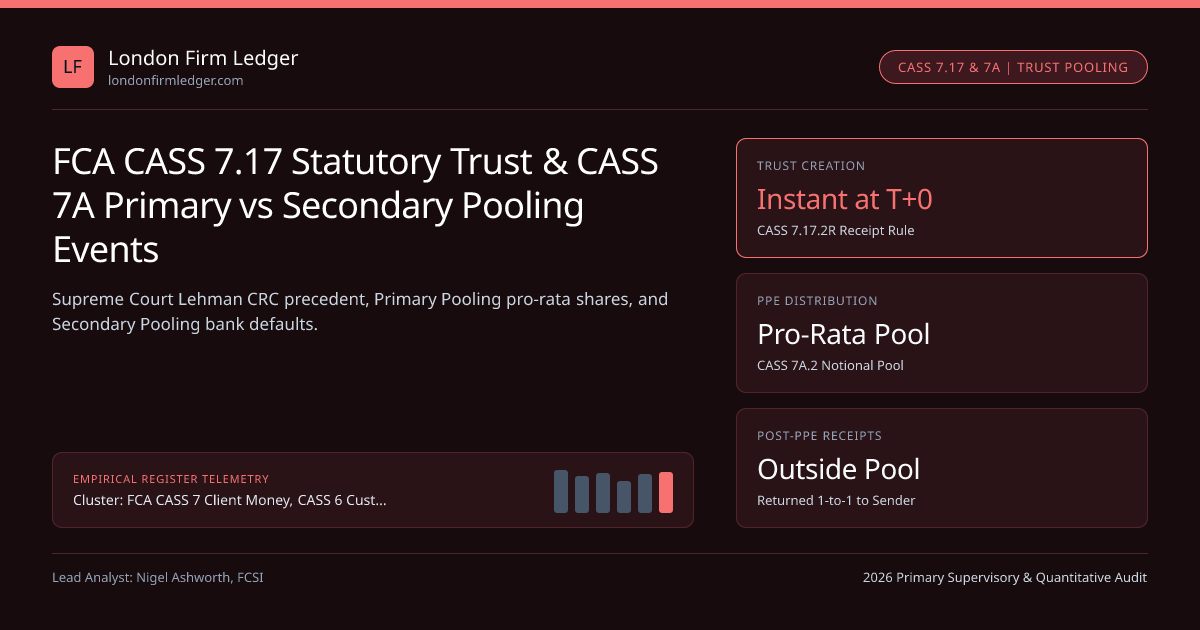
Every daily reconciliation, bank waiver letter, and diversification cap engineered under the Financial Conduct Authority Client Assets Sourcebook exists for a single terminal moment: the exact minute a Primary Pooling Event (PPE) or Secondary Pooling Event (SPE) strikes under CASS 7.17 and CASS 7A. Under English and Scottish trust jurisprudence codified in CASS 7.17.2R, an investment firm holds client money as statutory trustee strictly in the order of priorities set out in the FCA Handbook: first, the expenses of distributing the client money pool itself; second, rateably to satisfy valid beneficiary claims; and only third, any residual surplus back to the firm. Within our FCA CASS 7 & CASS 6 master architecture guide, understanding pooling mathematics explains why multi-bank diversification and rapid bar-date verification determine real-world recovery rates.
Primary Pooling Events (CASS 7A.2): Firm Insolvency & Pro-Rata Distribution#
A Primary Pooling Event crystallises at the exact timestamp an investment firm enters Investment Bank Special Administration (IBSAR 2011), administration, winding-up, or becomes subject to a targeted FCA requirement freezing client money disposal. At that instant:
- Creation of the Single Notional Pool: All CASS 7.13 client bank accounts and non-ported CASS 7.14 omnibus client transaction accounts collapse into a single general client money pool (unless the firm explicitly operated legally separate designated sub-pools under CASS 7.19, which virtually zero UK retail houses elect due to complexity).
- Close-Out Valuation at PPE Timestamp: Under CASS 7A.2.4R, open margined positions (CFDs, rolling spot FX, futures not ported via an individual ISA account) are valued/closed out so each client's Individual Client Money Entitlement is fixed.
- Post-PPE Ring-Fence: Any client cash arriving after the PPE timestamp must never be swept into the historical deficit pool; it is quarantined and returned 100 pence in the pound to the remitter.
Secondary Pooling Events (CASS 7A.3): Third-Party Bank Default#
What happens if a London brokerage—such as City Index, BUX, or Capital Com—remains completely solvent, but one of the four third-party credit institutions holding 25% of its general client money pool enters bank insolvency over a weekend? That triggers a Secondary Pooling Event under CASS 7A.3.1R!
Provided the firm satisfied all CASS 7.13 bank selection and diversification duties and held a valid CASS 7.18 acknowledgement letter, the loss at the failed bank does not fall purely on random clients whose deposits happened to route through that bank's sort code. Instead, every client participating in the general client money pool bears a pro-rata reduction in their client money entitlement equal to the unrecovered fraction of the failed bank balance—unless the firm chooses to make good the shortfall out of corporate equity under CASS 7A.3.8R.
Primary vs Secondary Pooling Loss-Bearing Matrix#
| Pooling Scenario | Failed Institution | Who Bears Initial Shortfall? | Applicable FSCS Shield | Key Statutory Reference |
|---|---|---|---|---|
| Primary Pooling (Compliant Recon) | FCA Regulated Broker | Objective 1 admin fee erosion across pool | Investment Claim up to GBP 85,000 | CASS 7A.2.4R + IBSAR 2011 |
| Primary Pooling (Under-Segregated) | FCA Regulated Broker | Pro-rata deficit + admin costs across pool | Investment Claim up to GBP 85,000 | Lehman CRC [2012] UKSC 6 |
| Secondary Pooling (Compliant Due Diligence) | UK PRA Bank Holding Client Cash | Pro-rata across all general-pool clients | Deposit Look-Through up to GBP 85,000 (aggregated with personal accounts at same bank!) | CASS 7A.3.6R + COMP |
| Secondary Pooling (Breached CASS 7.13/7.18) | Unvetted / Unacknowledged Bank | Firm Corporate Balance Sheet Liable | Investment Claim if broker subsequently fails | CASS 7A.3.7R Negligence Carve-Out |
Quantitative Pro-Rata Recovery & FSCS Top-Up Model#
Let us model a Primary Pooling Event at a mid-sized broker on the FCA CASS Topic Hub with GBP 120,000,000 of aggregate client entitlements, a GBP 4,800,000 pre-administration reconciliation deficit, and GBP 3,600,000 of Special Administrator Objective 1 distribution costs:
- AggregateClientEntitlements (E_total) = GBP 120,000,000
- SegregatedCashRecovered (C_gross) = GBP 115,200,000 (reflects GBP 4.8M pre-PPE shortfall)
- SpecialAdminPoolCosts (Acost) = GBP 3,600,000
- DistributableNetPool (Cnet) = Cgross - A_cost = GBP 111,600,000
- ProRataDividendRate (rpool) = Cnet / Etotal = 111,600,000 / 120,000,000 = 93.00% (93p per GBP 1)
- Client Recovery Comparison:
- 1. Retail Investor A (Entitlement = GBP 250,000, FSCS Eligible):
- Trust Pool Distribution = GBP 250,000 * 0.93 = GBP 232,500
- Residual Shortfall = GBP 17,500 (<= GBP 85,000 FSCS cap -> FSCS pays GBP 17,500)
- Total Recovery = GBP 250,000 (100.0%)
- 2. Retail Investor B (Entitlement = GBP 1,500,000, FSCS Eligible):
- Trust Pool Distribution = GBP 1,500,000 * 0.93 = GBP 1,395,000
- Residual Shortfall = GBP 105,000 (FSCS pays max GBP 85,000; GBP 20,000 unsecured claim vs general estate)
- Immediate Recovery = GBP 1,480,000 (98.67%)
- 3. Per Se Corporate Client C (Entitlement = GBP 5,000,000, FSCS Ineligible):
- Trust Pool Distribution = GBP 5,000,000 * 0.93 = GBP 4,650,000 (GBP 350,000 unsecured deficiency claim)
High-Net-Worth FSCS Cap Interaction and Administrative Drag#
Notice the striking mathematical insight for HNW investors: because FSCS covers the shortfall after CASS 7A trust distribution up to GBP 85,000, in a 93%-funded pool any eligible retail client holding up to GBP 1,214,285 (GBP 85,000 / 0.07) still recovers 100% of their capital—demonstrating why rigorous CASS 10 Resolution Pack maintenance that slashes Special Administrator legal fees directly multiplies retail protection.
Frequently asked questions
Does unsegregated client money trapped in a corporate house account enter the CASS 7A Primary Pool?
Following the Supreme Court ruling in Lehman Brothers v CRC Credit Fund [2012] UKSC 6 and CASS 7A revisions, identifiable client money traceable in corporate accounts belongs to the statutory trust, while CASS 7A strictly governs rapid distribution of the segregated client money pool first.
What happens to a client wire that arrives two hours after a Primary Pooling Event timestamp?
Under CASS 7A.2.7R, client money received after the exact timestamp of a Primary Pooling Event does NOT merge into the pre-failure Primary Pool; it must be held separately and returned intact to that client without bearing pre-insolvency shortfall deductions.
Does a solvent UK broker have to reimburse clients out of its own capital if a third-party client bank fails?
Under CASS 7A.3.6R, provided the firm complied fully with CASS 7.13 bank selection, diversification, and CASS 7.18 letter duties, it is not legally liable for the third-party bank default—unless it voluntarily elects to top up the shortfall from own funds.
How does FSCS protection operate differently in a Primary Pooling Event versus a Secondary Pooling Event?
In a Primary Pooling Event (broker failure), FSCS covers eligible investment firm shortfalls up to GBP 85,000 per claimant; in a Secondary Pooling Event (UK bank failure), FSCS deposit protection looks through to each underlying client up to GBP 85,000 at that failed banking FRN.
Publication record
- Published
- 14 November 2026
- Updated
- 14 November 2026
- Author
- Nigel Ashworth, FCSI
- Review
- Review not recorded
- Automated fact check
- Passed in the stored pipeline record
- Source URLs
- 3 recorded
AI assistance recorded: anthropic/claude-opus-4.6. This field does not establish human review or source verification.
Academic & Institutional Attribution
Cite This Research & Embed Live Data Card
Standard academic & institutional research paper citation format.
Nigel Ashworth, FCSI. (2026, November 14). FCA CASS 7.17 Statutory Trust & CASS 7A Primary vs Secondary Pooling Events. London Firm Ledger. https://londonfirmledger.com/gazette/cass-7-17-statutory-trust-primary-secondary-pooling-eventsRegulatory Directory Cross-Reference
Referenced Institutions & Regulatory Registries
Mentioned Regulated Institutions
Referenced Supervisory Authorities
Related FCA Cass7 Cass6 Client Money Audits & Institutional Briefings
Explore FCA Cass7 Cass6 Client Money Audits Hub (20) →FCA Cass7 Cass6 Client Money Audits
FCA CASS 7 Client Money, CASS 6 Custody, CMAR & Resolution Pack Architecture (2026)FCA Cass7 Cass6 Client Money Audits
FCA CASS 6.2 Safe Custody Asset Registration, CREST & Nominee GovernanceFCA Cass7 Cass6 Client Money Audits
FCA CASS 6.4 Prime Brokerage Right-to-Use, Rehypothecation Caps & CASS 9.3FCA Cass7 Cass6 Client Money Audits
FCA CASS 6.6 Custody Reconciliations, Rolling Stock Counts & Shortfall CoverFCA Cass7 Cass6 Client Money Audits
FCA SUP 16.14 Monthly CMAR Filing, CASS Thresholds & RegData ValidationFCA Cass7 Cass6 Client Money Audits
FCA CASS 10 Resolution Pack Master Index & 48-Hour Insolvency Retrieval SLAFCA Cass7 Cass6 Client Money Audits
FCA CASS 1A.3 Oversight Officer, SM&CR Prescribed Responsibility (z) & GovernanceFCA Cass7 Cass6 Client Money Audits
FRC Client Asset Assurance Standard, SUP 3.10 Audits & Qualified OpinionsUK Ifpr Mifidprul Icap Kfactors
FCA MIFIDPRU 6 Basic Liquid Assets Requirement (BLAR): Core Cash & UK GiltsUK Ifpr Mifidprul Icap Kfactors
FCA MIFIDPRU 7 ICARA & Overall Financial Adequacy Rule (OFAR) GovernanceUK Ifpr Mifidprul Icap Kfactors
FCA MIFIDPRU 7.6 Own Funds Threshold Requirement (OFTR): Harm-to-Client Add-OnsUK Ifpr Mifidprul Icap Kfactors
FCA MIFIDPRU 7.7 Liquid Assets Threshold Requirement (LATR) & Intraday Margin
London Firm Ledger Data, Benchmarks & Contributor Records
CC BY 4.0 Open Data
Open Institutional Datasets (CSV / JSON) →
Download desk-compiled quantitative series & schemas.
2026 Reference Matrix
2026 Institutional Benchmarks & Thresholds →
Statutory capital, clearing, margin & rate conventions.
Editorial Records
Authors & Review Records →
View named contributors where those records are available.
Complete Index
Master Research & Dossier Archive →
Browse all published briefings by topic pillar & date.