
Fscs Compensation Pra Ring Fencing
PRA Bank Ring-Fencing: Core Deposit Thresholds (GBP 35B) & Excluded Activities
Enacted after the Vickers Independent Commission on Banking, FSMA Part 9B requires UK banking groups holding above GBP 35 billion in core retail and SME deposits to wall off deposit-taking from proprietary trading and wholesale investment banking.
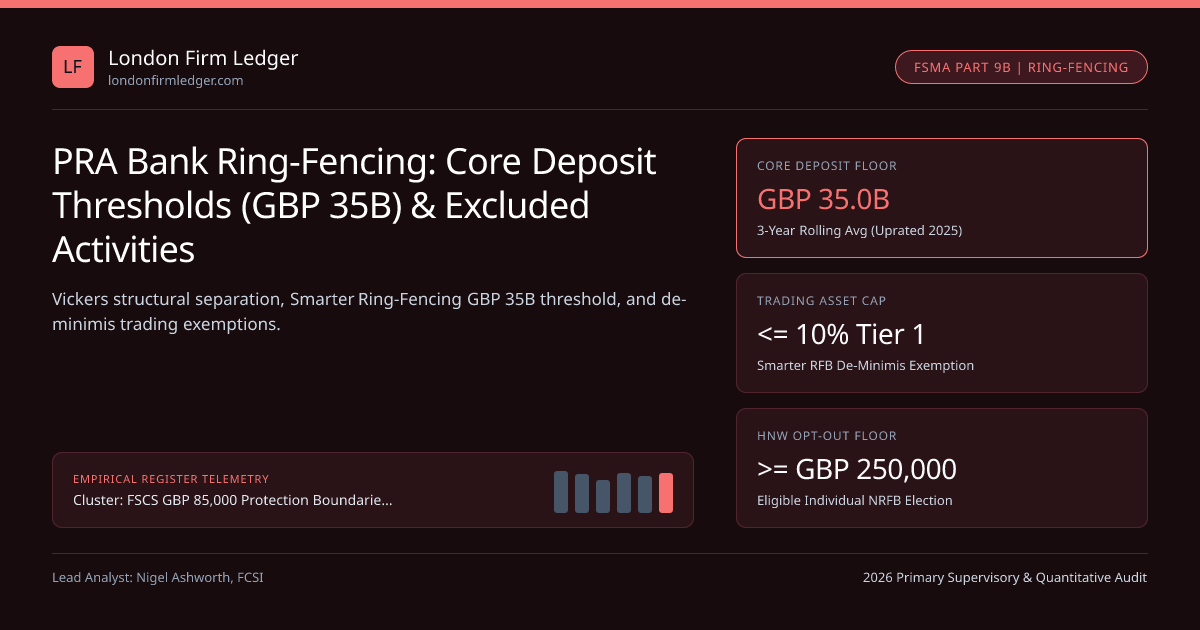
During the 2008 global financial crisis, UK retail depositors and payment systems at universal banks such as RBS and HBOS were held hostage to multi-billion-pound subprime credit-trading losses booked on the exact same legal balance sheet. Rather than enacting a total 1933 Glass-Steagall ownership ban, Parliament implemented Sir John Vickers' blueprint via FSMA 2000 Part 9B (Sections 142A–142Z1)—requiring large UK banking groups to erect an internal structural firewall supervised by the Prudential Regulation Authority and the Bank of England.
Within our FSCS, IBSAR & PRA master guide, PRA bank ring-fencing shapes every institutional banking relationship in the City of London: it explains why an FCA CFD house like City Index or an OTC liquidity desk like B2C2 must clear wholesale credit lines through Barclays Bank plc (NRFB) or NatWest Markets plc (NRFB) rather than Barclays Bank UK plc (RFB)!
Structural Split Inside Universal UK Banking Groups (RFB vs NRFB)#
Compare what sits inside a PRA Ring-Fenced Body versus what is legally forced outside under SI 2014/1960 (Core Activities Order) and SI 2014/2080 (Excluded Activities and Prohibitions Order):
| Banking Activity / Counterparty | Ring-Fenced Body (RFB — e.g., HSBC UK Bank plc) | Non-Ring-Fenced Bank (NRFB — e.g., HSBC Bank plc) | Statutory Basis & Supervisory Rationale |
|---|---|---|---|
| UK Retail & SME Core Deposits | MANDATORY (Core Activity) | PROHIBITED (Cannot accept core retail deposits!) | FSMA s142B & SI 2014/1960 — Insulates everyday CHAPS/Faster Payments & FSCS deposits |
HNW (>= GBP 250k) & Large Corporate Deposits | Permitted | Permitted (if HNW signs formal Eligibility Declaration) | Allows multinationals & family offices to hold multi-currency cash alongside wholesale FX desks |
| Proprietary & Principal Securities / Commodities Dealing | STRICTLY PROHIBITED (subject to narrow treasury hedging) | Permitted (Market-making, repo, equity derivatives, underwriting) | SI 2014/2080 Art 4–5 — Blocks trading losses from eroding retail bank CET1 |
Lending to Hedge Funds, Investment Firms & Insurers (RFIs) | PROHIBITED (Relevant Financial Institution exposure ban!) | Permitted (Prime brokerage, margin lending, broker credit lines) | SI 2014/2080 Art 14 — Blocks financial-sector contagion entering the RFB |
| Direct Non-UK Branch / Subsidiary Operations | Restricted (Historically EEA/UK; eased slightly for servicing under Smarter RFB reforms) | Permitted Globally (New York, Singapore, Hong Kong, Tokyo) | Prevents foreign sovereign/resolution freezes trapping UK retail bank capital |
Why FCA Brokers Struggle to Obtain Overdrafts From High-Street RFBs#
Look closely at row 4 in the comparison table (Relevant Financial Institution (RFI) Exposure Prohibition, SI 2014/2080 Article 14): an FCA MiFID investment firm holding Part 4A dealing/managing permissions is legally classified as a Relevant Financial Institution! Consequently:
- A Ring-Fenced Bank (
Lloyds Bank plcorBarclays Bank UK plc) can accept passive segregated CASS 7 client money deposits (because taking deposits creates a liability on the RFB's balance sheet, not a credit exposure to the broker!). - However, that exact same RFB is statutorily barred from granting an intraday overdraft or corporate revolving credit facility to the investment firm (outside narrow payment-settlement timing exceptions under
Art 14(2)), forcing the broker to establish credit lines with the group's NRFB (Barclays Bank plcorNatWest Markets plc) or specialist wholesale banks!
Quantitative Smarter Ring-Fencing Threshold & Trading De-Minimis Test#
Under HM Treasury's Smarter Ring-Fencing Regime reforms following the independent Skeoch Panel Review, let us model whether an expanding UK challenger bank (GBP 38.0B core deposits, GBP 2.90B Tier 1 capital, minimal treasury gilts/swaps) is forced to spend GBP 300M splitting its IT and legal charter:
- Limb 1 (Core Deposit Threshold):
- 3YrAvgCoreDeposits = (D{t-2} + D{t-1} + Dt) / 3 > GBP 35,000,000,000
- Limb 2 (Secondary Excluded-Activities De-Minimis Exemption Test):
- TradingAssetsRatio = ExcludedTradingFinancialAssets / Tier1_Capital <= 10.0% (and zero complex derivatives)
- Worked Challenger Bank Assessment (D_avg = GBP 38.0B, Tier 1 = GBP 2.90B):
- Case A — Pure Retail/SME Challenger (Excluded Assets = GBP 140M Gilts/FX Spot):
- Davg = GBP 38.0B > GBP 35.0B, BUT TradingAssets_Ratio = 140M / 2,900M = 4.83% <= 10.0%
- > EXEMPT Under Secondary Trading De-Minimis Threshold (Can Acquire Smaller Rivals Without Splitting!)
- Case B — Universal Group Acquiring Investment Dealer (Excluded Assets = GBP 920M):
- TradingAssetsRatio = 920M / 2,900M = 31.72% > 10.0%
- > MUST Establish Separate PRA Ring-Fenced Sub-Group Within Statutory Transition Period!
Benchmarking UK Ring-Fenced vs Non-Ring-Fenced Balance Sheets#
Enforcing Real Independence Across the Ring-Fence Wall#
Splitting legal entities on UK Companies House would achieve nothing if the parent HoldCo CEO could quietly order the RFB to lend GBP 8 billion overnight to prop up a failing sibling NRFB! Next, we examine how the PRA polices board, risk, intragroup large-exposure, and arm's-length rules inside PRA RFB governance independence & intragroup exposure caps and 24-hour Single Customer View rules on our FSCS & PRA Topic Hub.
Frequently asked questions
Which UK banking groups currently operate mandatory PRA Ring-Fenced Bodies (RFBs)?
The major UK ring-fenced banking groups supervised by the PRA include Barclays (Barclays Bank UK plc vs NRFB Barclays Bank plc), HSBC (HSBC UK Bank plc vs NRFB HSBC Bank plc), Lloyds Banking Group, NatWest Group (NatWest/RBS/Coutts inside RFB sub-group vs NatWest Markets plc NRFB), and Santander UK.
Why did Pure Investment Banks like Goldman Sachs International or Morgan Stanley avoid UK ring-fencing?
Because ring-fencing under FSMA Part 9B only triggers when a UK group holds above GBP 35 billion (previously GBP 25 billion) in CORE retail and small-business EEA/UK deposits! Wholesale investment banks funded by institutional paper, repo, and HNW/large-corporate deposits stay below the core deposit floor.
What did HM Treasury Smarter Ring-Fencing Reforms change alongside raising the GBP 25B threshold to GBP 35B?
Follow-up reforms from the Skeoch Review raised the core deposit threshold from GBP 25B to GBP 35B, introduced a secondary trading-asset de-minimis exemption allowing retail-focused banks with minimal wholesale trading (<= 10% of Tier 1 capital) to avoid costly structural splitting, and eased minor SME equity/Geographic constraints.
Can a PRA Ring-Fenced Bank lend money directly to a Cayman hedge fund or FCA CFD brokerage?
Generally NO! Under the Financial Services and Markets Act 2000 (Excluded Activities and Prohibitions) Order 2014 (SI 2014/2080), RFBs are strictly prohibited from incurring credit exposures to "relevant financial institutions" (RFIs)—such as investment banks, hedge funds, and non-ring-fenced brokers—subject only to narrow payment/trade-finance exceptions!
Publication record
- Published
- 13 November 2026
- Updated
- 15 November 2026
- Author
- Nigel Ashworth, FCSI
- Review
- Review not recorded
- Automated fact check
- Passed in the stored pipeline record
- Source URLs
- 4 recorded
AI assistance recorded: anthropic/claude-opus-4.6. This field does not establish human review or source verification.
Academic & Institutional Attribution
Cite This Research & Embed Live Data Card
Standard academic & institutional research paper citation format.
Nigel Ashworth, FCSI. (2026, November 15). PRA Bank Ring-Fencing: Core Deposit Thresholds (GBP 35B) & Excluded Activities. London Firm Ledger. https://londonfirmledger.com/gazette/pra-ring-fencing-35-billion-core-deposits-excluded-activitiesRegulatory Directory Cross-Reference
Referenced Institutions & Regulatory Registries
Mentioned Regulated Institutions
Referenced Supervisory Authorities
Related Fscs Compensation Pra Ring Fencing & Institutional Briefings
Explore Fscs Compensation Pra Ring Fencing Hub (20) →Fscs Compensation Pra Ring Fencing
FSCS GBP 85,000 Protection, IBSAR Special Administration & PRA Ring-Fencing Guide (2026)Fscs Compensation Pra Ring Fencing
PRA Ring-Fenced Body Governance: Board Independence, Intragroup Caps & Arm's-Length RulesFscs Compensation Pra Ring Fencing
PRA Single Customer View (SCV) & Exclusions View: 24-Hour FSCS File Verification RulesFscs Compensation Pra Ring Fencing
Bank of England MREL, Bail-In Resolution & the UK Insolvency Creditor HierarchyFscs Compensation Pra Ring Fencing
PRA SS2/21 Outsourcing & Third-Party Risk: Cloud Concentration, Audit & Step-In RightsFscs Compensation Pra Ring Fencing
PRA PS21/1 & FCA PS21/3 Operational Resilience: Impact Tolerances & Severe ScenariosFscs Compensation Pra Ring Fencing
PRA Basel 3.1 (PS17/23 & PS9/24): UK RWA Output Floor, FRTB & SME Lending RulesFscs Compensation Pra Ring Fencing
PRA Pillar 2A, Pillar 2B (PRA Buffer), ICAAP & ILAAP Supervisory Reviews (SREP)Cbi Ireland Gibraltar Gfsc Authorisation
Gibraltar Financial Services Act 2019 (FSA 2019): Permissions & Regulated Individuals (RIP)Cbi Ireland Gibraltar Gfsc Authorisation
Gibraltar GFSC DLT Providers Regime: All 10 Regulatory Principles & Market IntegrityCbi Ireland Gibraltar Gfsc Authorisation
UK–Gibraltar Authorisation Regime (GAR): Financial Services Act 2021 Schedule 2A Market AccessCbi Ireland Gibraltar Gfsc Authorisation
Gibraltar Deposit Guarantee (GDGS), Investor Compensation (GICS) & UK FSCS GAR Parity
London Firm Ledger Data, Benchmarks & Contributor Records
CC BY 4.0 Open Data
Open Institutional Datasets (CSV / JSON) →
Download desk-compiled quantitative series & schemas.
2026 Reference Matrix
2026 Institutional Benchmarks & Thresholds →
Statutory capital, clearing, margin & rate conventions.
Editorial Records
Authors & Review Records →
View named contributors where those records are available.
Complete Index
Master Research & Dossier Archive →
Browse all published briefings by topic pillar & date.