
Fscs Compensation Pra Ring Fencing
PRA Pillar 2A, Pillar 2B (PRA Buffer), ICAAP & ILAAP Supervisory Reviews (SREP)
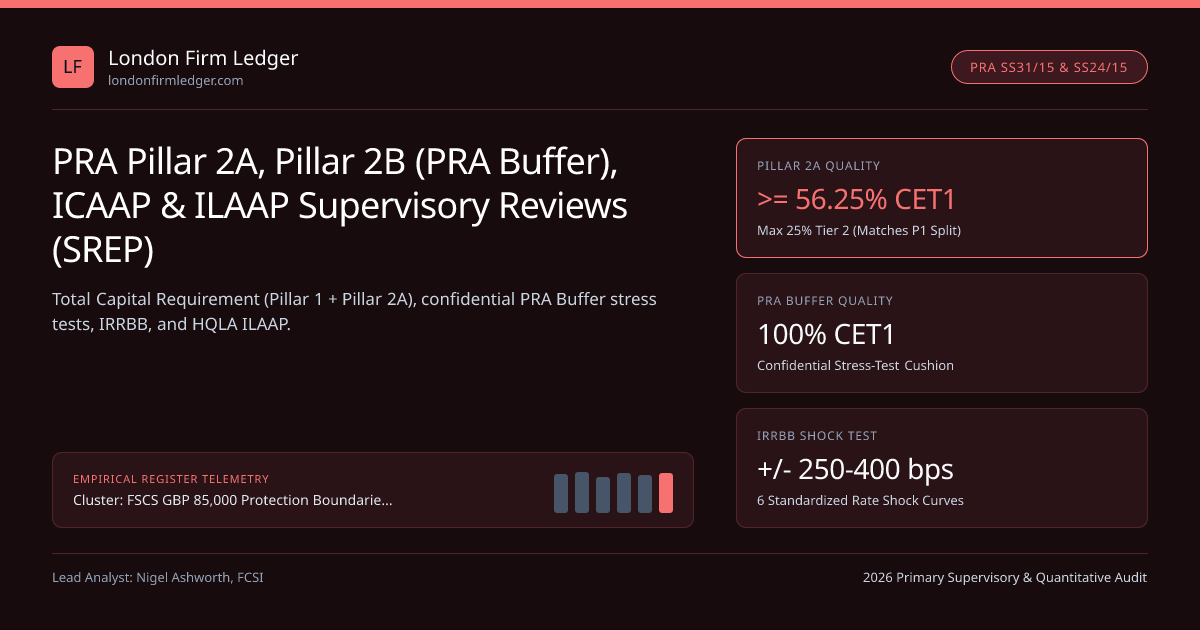
While Pillar 1 sets uniform RWA formulas, PRA Supervisory Statements SS31/15 (ICAAP/SREP) and SS24/15 (ILAAP) tailor Total Capital Requirements (TCR) and HQLA liquidity buffers to each UK bank's Interest Rate Risk in the Banking Book (IRRBB), concentration, and stress resilience.
When Silicon Valley Bank (SVB) imploded in California in March 2023 after rising Treasury yields wiped out its unhedged Held-to-Maturity bond portfolio, global investors asked an immediate question: could a mid-sized UK bank holding GBP 15 billion of unhedged 10-year UK Gilts suffer the exact same invisible solvency wipeout? The answer across the Prudential Regulation Authority perimeter was an emphatic no—because unlike US tailoring rules that exempted mid-sized banks from Basel Pillar 2 Interest Rate Risk in the Banking Book (IRRBB), PRA Supervisory Statement SS31/15 enforces binding Pillar 2A IRRBB capital charges on every UK bank from Day 1 of authorisation!
Within our FSCS, IBSAR & PRA master guide, ICAAP (SS31/15), ILAAP (SS24/15), and the PRA's Supervisory Review and Evaluation Process (C-SREP & L-SREP) determine the real binding capital and High-Quality Liquid Asset (HQLA) stack of every UK credit institution.
Anatomy of the Complete UK PRA Bank Capital Stack (Bottom to Top)#
Compare every layer of a UK bank's CET1 and Total Capital requirement—noting what is publicly disclosed in Pillar 3 versus kept strictly confidential:
| Capital Layer (Bottom -> Top) | Typical Calibration (% of RWAs) | Minimum CET1 Quality | Public or Confidential? | Regulatory Consequence of Breach |
|---|---|---|---|---|
1. Pillar 1 Minimum (CRR Art 92) | 8.00% Total (4.50% CET1, 1.50% AT1, 2.00% T2) | 56.25% CET1 (4.5 / 8.0) | Public | Threshold Condition failure / BoE Resolution |
2. Pillar 2A (PRA C-SREP TCR Add-On) | 1.50% – 5.50% RWAs (IRRBB, Credit Conc., Pension, OpRisk) | >= 56.25% CET1 (>= 75% Tier 1) | Public (TCR = P1 + P2A disclosed!) | Breaching TCR violates binding PRA capital requirement! |
3. Capital Conservation Buffer (CCB) | 2.50% RWAs (Fixed statutory buffer) | 100% CET1 | Public | Triggers automatic MDA restrictions on dividends, AT1 coupons, & MRT bonuses! |
4. UK Countercyclical Buffer (CCyB) | 2.00% UK Standard Neutral Rate (FPC-set 0%–2.5%+) | 100% CET1 | Public | Part of Combined Buffer (CBR) -> triggers MDA restrictions |
| 5. G-SII / O-SII Systemic Buffer | 0.00% – 2.50% RWAs (Major global / UK RFBs) | 100% CET1 | Public | Part of Combined Buffer (CBR) -> triggers MDA restrictions |
6. Pillar 2B (The PRA Buffer) | 0.50% – 4.00%+ RWAs (Net stress depletion + governance scalar!) | 100% CET1 | STRICTLY CONFIDENTIAL! | Usable in stress; triggers private PRA Capital Restoration Plan (NO automatic MDA halt!) |
Post-2023 ILAAP Upgrades: Digital Social-Media Bank Runs & Intraday RTGS Peaks#
Following the 48-hour smartphone-driven deposit runs at SVB (USD 42B withdrawn in 10 hours!) and Credit Suisse in 2023, PRA L-SREP reviews under SS24/15 scrutinized two critical liquidity assumptions inside UK banks' ILAAP documents:
- Uninsured Digital Deposit Outflow Multipliers: Standard Basel
LCRassumes10%to40%30-day outflows on non-operational corporate deposits. Where a challenger bank relies heavily on rate-chasing aggregator deposits or concentrated VC/fintech corporate treasuries, the PRA imposes Pillar 2 Liquidity Guidance demanding extra Level-1 Bank of England Reserve Account cash and unencumbered UK Gilts pre-positioned inside the Bank of England Sterling Monetary Framework (SMF— Indexed Long-Term Repo & Discount Window Facility)! - Intraday Bank of England RTGS Liquidity Usage: Because CHAPS settles gross in real time (
T+0), a bank must hold dedicated intraday HQLA to fund morning outbound payment spikes before afternoon inbound receipts arrive!
Worked Total Capital Requirement (TCR), Combined Buffer & PRA Buffer Stack#
Let us compute the exact minimum CET1 ratio and Total Capital stack for a mid-tier UK Ring-Fenced Bank (RWAs = GBP 40.0 billion, Pillar 2A = 3.20%, O-SII Buffer = 1.00%, UK CCyB = 2.00%, CCB = 2.50%, and a 5-year stress peak CET1 depletion of 6.40% plus a 0.50% PRA governance scalar):
- TotalTCRRatio = 8.00% (Pillar 1) + 3.20% (Pillar 2A) = 11.20% of RWAs (GBP 4,480M)
- MinCET1In_TCR = 0.5625 * 11.20% = 6.30% of RWAs (GBP 2,520M)
- MaxAT1InTCR = 0.1875 * 11.20% = 2.10% of RWAs | MaxT2InTCR = 0.2500 * 11.20% = 2.80% of RWAs
- Step 2 — Public Combined Buffer Requirement (CBR — 100% CET1, MDA Trigger Line):
- CBRRatio = CCB (2.50%) + UKCCyB (2.00%) + O_SII (1.00%) = 5.50% CET1 (GBP 2,200M)
- PublicMDACET1Trigger = MinCET1InTCR (6.30%) + CBR (5.50%) = 11.80% CET1! (Assuming full AT1/T2 filled)
- Step 3 — Confidential Pillar 2B (PRA Buffer — Offset Against CCB + CCyB = 4.50%!):
- NetStressPRABuffer = max(0, StressDrawdown (6.40%) - UsableCCBCCyB (4.50%)) + Governance_Scalar (0.50%)
- = 1.90% + 0.50% = 2.40% CET1 (GBP 960M)
- FullSupervisoryCET1_Expectation = 11.80% + 2.40% = 14.20% CET1 (Bank Sets Internal Management Target = 15.0%!)
Visualizing the UK Bank CET1 Stack & MDA Trigger Threshold#
What If an International Bank Operates in London as a Branch Instead of a UK Subsidiary?#
Notice that every ICAAP, ILAAP, TCR, and PRA Buffer rule above applies to UK-incorporated PRA banks! What if a global Wall Street, Zurich, Frankfurt, or Tokyo bank operates in the City of London via a UK branch rather than a separately capitalised UK subsidiary? The PRA polices that exact structural threshold under Supervisory Statement SS5/21—examined next in UK overseas bank branch vs PRA subsidiary supervision (SS5/21) alongside PRA Basel 3.1 PS9/24 rules on our FSCS & PRA Topic Hub.
Frequently asked questions
What is the difference between breaching the PRA Buffer (Pillar 2B) vs breaching the Combined Buffer (MDA) or TCR?
The PRA Buffer (Pillar 2B) is CONFIDENTIAL and sits at the very top of the capital stack: dipping into it during stress triggers enhanced supervisory dialogue and a Capital Restoration Plan, WITHOUT triggering automatic public Maximum Distributable Amount (MDA) AT1 coupon/dividend bans (which fire when breaching the Combined Buffer) or Threshold Condition failure (TCR breach)!
Why must Pillar 2A be met with at least 56.25% CET1 and at least 75% Tier 1 capital?
Mirroring Pillar 1 (where 4.5% CET1 / 8.0% Total = 56.25% and 6.0% Tier 1 / 8.0% Total = 75.0%), PRA Capital Buffers and Pillar 2A rules require at least 56.25% of Pillar 2A to be met with CET1 and no more than 25% with Tier 2 subordinated debt.
How did UK Pillar 2A IRRBB rules prevent a SVB-style unhedged UK gilt catastrophe?
Under PRA Rulebook ICAA Chapter 9 and SS31/15, every UK bank must shock its entire banking book across six BCBS interest-rate scenarios (parallel up/down, steepener, flattener, short-rate up/down) and hold hard Pillar 2A CET1/Tier 1 capital against net EVE sensitivity—forcing UK treasurers to hedge fixed-rate gilts and mortgages with SONIA swaps!
How does a bank PRA ICAAP/ILAAP differ from an FCA investment firm MIFIDPRU 7 ICARA?
Dual-regulated and solo PRA banks run TWO separate assessments—ICAAP (SS31/15 capital + TCR/PRA Buffer set via PRA C-SREP) and ILAAP (SS24/15 HQLA liquidity + L-SREP)—whereas FCA solo-regulated investment firms integrate capital, liquidity, and wind-down into a single unified ICARA document under MIFIDPRU 7!
Publication record
- Published
- 13 November 2026
- Updated
- 15 November 2026
- Author
- Nigel Ashworth, FCSI
- Review
- Review not recorded
- Automated fact check
- Passed in the stored pipeline record
- Source URLs
- 4 recorded
AI assistance recorded: anthropic/claude-opus-4.6. This field does not establish human review or source verification.
Academic & Institutional Attribution
Cite This Research & Embed Live Data Card
Standard academic & institutional research paper citation format.
Nigel Ashworth, FCSI. (2026, November 15). PRA Pillar 2A, Pillar 2B (PRA Buffer), ICAAP & ILAAP Supervisory Reviews (SREP). London Firm Ledger. https://londonfirmledger.com/gazette/pra-pillar-2a-pillar-2b-icaap-ilaap-srep-capital-liquidityRegulatory Directory Cross-Reference
Referenced Institutions & Regulatory Registries
Top Regulated Institutions in This Coverage Slice
Referenced Supervisory Authorities
Related Fscs Compensation Pra Ring Fencing & Institutional Briefings
Explore Fscs Compensation Pra Ring Fencing Hub (20) →Fscs Compensation Pra Ring Fencing
FSCS GBP 85,000 Protection, IBSAR Special Administration & PRA Ring-Fencing Guide (2026)Fscs Compensation Pra Ring Fencing
PRA SS5/21 International Banks: UK Branch vs Subsidiary Thresholds (GBP 130m / GBP 500m)Fscs Compensation Pra Ring Fencing
FSCS Levy Mechanics: Management Expenses Levy Limit (MELL), Classes & Retail Pool CapsFscs Compensation Pra Ring Fencing
FCA COMP 4.2 Eligible Claimants: Retail, Micro-Enterprise & Institutional ExclusionsFscs Compensation Pra Ring Fencing
FCA COMP 5.5 Designated Investment Business vs Spot FX, Bullion & Crypto GapsFscs Compensation Pra Ring Fencing
PRA Deposit Protection: GBP 85k Single, GBP 170k Joint, Shared FRNs & GBP 1M THB RulesFscs Compensation Pra Ring Fencing
FSCS Look-Through Deposit Protection on Segregated CASS 7 Balances in Bank InsolvencyFscs Compensation Pra Ring Fencing
EMI & Payment Institution Safeguarding vs FSCS: Non-Coverage & FCA CASS 15 ReformsCbi Ireland Gibraltar Gfsc Authorisation
Trilateral London, Dublin & Gibraltar Booking Models: Client Protection & Capital MatrixCbi Ireland Gibraltar Gfsc Authorisation
UK Overseas Persons Exclusion (RAO Art 72) vs ESMA MiFID II Reverse Solicitation (Art 42)Banking and Finance
Barclays Enlists Its Best People and Tech to Take on the UK's Biggest Money Challenges — LBB - LBB - Little Black BookMarket Insights
HSBC ‘aiming for spring 2027’ for new London HQ opening - FStech
London Firm Ledger Data, Benchmarks & Contributor Records
CC BY 4.0 Open Data
Open Institutional Datasets (CSV / JSON) →
Download desk-compiled quantitative series & schemas.
2026 Reference Matrix
2026 Institutional Benchmarks & Thresholds →
Statutory capital, clearing, margin & rate conventions.
Editorial Records
Authors & Review Records →
View named contributors where those records are available.
Complete Index
Master Research & Dossier Archive →
Browse all published briefings by topic pillar & date.