
Fscs Compensation Pra Ring Fencing
PRA Basel 3.1 (PS17/23 & PS9/24): UK RWA Output Floor, FRTB & SME Lending Rules
Under Policy Statements PS17/23 and PS9/24, the Prudential Regulation Authority completes post-crisis Basel 3.1 capital reforms for UK banks and PRA investment firms—introducing a 72.5% RWA Output Floor, Fundamental Review of the Trading Book (FRTB), and risk-sensitive LTV credit weights.
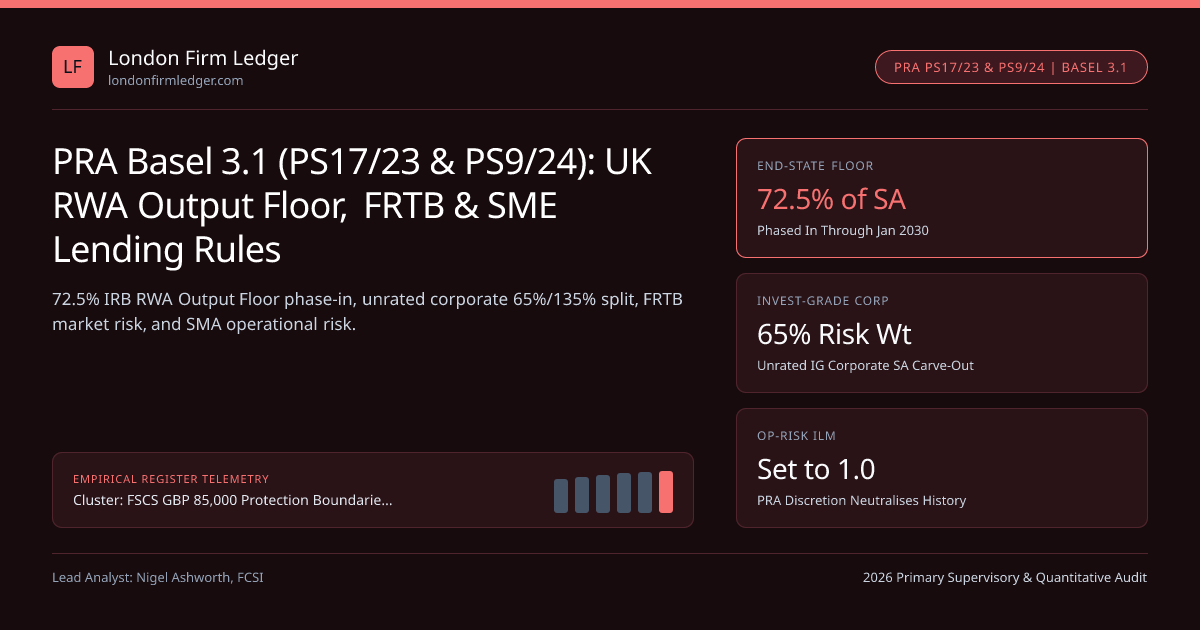
Across Threadneedle Street and Canary Wharf, PRA Policy Statements PS17/23 (Part 1: Market, CVA, Operational Risk) and PS9/24 (Part 2: Credit Risk, Output Floor, Reporting & Pillar 2 Adjustments)—alongside the PRA's competitiveness alignment schedule matching US/EU implementation timing into 2027–2030—represent the largest overhaul of UK bank Risk-Weighted Asset (RWA) math since Basel II in 2007!
Within our FSCS, IBSAR & PRA master guide, understanding PRA Basel 3.1 is vital for two audiences: UK banking strategists at groups like Barclays, HSBC, Lloyds, and NatWest repricing corporate credit lines and prime brokerage balance sheets, and institutional brokers comparing PRA-designated bank dealers against FCA MIFIDPRU investment houses (UK MIFIDPRU IFPR Framework) such as City Index or Britannia Global Markets.
Five Structural Reforms Across PRA PS17/23 & PS9/24#
| Prudential Risk Pillar | Legacy UK CRR Baseline | PRA Basel 3.1 (PS17/23 & PS9/24) | Strategic Balance-Sheet Impact in London |
|---|---|---|---|
| 1. Aggregate RWA Output Floor | None (0% floor on IRB vs Standardised) | 72.5% of Standardised Approach (SA) RWAs at end-state (1 Jan 2030) | Caps maximum IRB model RWA discount at 27.5% across major UK universal banks |
2. Residential Mortgages (SA) | Blunt 35% flat weight up to 80% LTV | Granular Loan-Splitting / Whole-Loan LTV ladder (20% at <=50% LTV up to 70% at >100% LTV; higher for income-dependent BTL) | Rewards Challenger SA banks writing low-LTV (<= 60%) owner-occupied UK mortgages! |
| 3. Unrated Corporate & SME Credit | Flat 100% unrated corporate + 0.7619 EU SME factor | 65% Investment-Grade Unrated Corporate, 85% Corporate SME, + Pillar 2A SME Lending Adjustment | Keeps aggregate UK SME lending capital neutral (0% net hike) via Pillar 2A offset! |
4. Market Risk (FRTB) | 99% 10-day VaR + Stressed VaR | 97.5% Expected Shortfall (ES) across 10–120d liquidity horizons + ASA Sensitivities (SBM + DRC + RRAO) | Penalises illiquid credit/exotic trading inventories; enforces strict Trading/Banking Book wall |
5. Operational Risk (SA) | BIA (15%), TSA (12%–18%), or AMA models | Single Business Indicator Component (BIC) (12% / 15% / 18% marginal tiers) with ILM = 1.0 | Predictable revenue/expense-driven Pillar 1 formula; conduct tail risk stays in Pillar 2A |
Why "Strong and Simple" (SDDT) Shields Challenger UK Banks#
Instead of forcing an GBP 8 billion regional building society or specialist SME bank to build FRTB sensitivities engines designed for global Wall Street/Canary Wharf dealers, the Prudential Regulation Authority created the Small Domestic Deposit Takers (SDDT) regime (Strong and Simple Framework): eligible domestic-focused banks (< GBP 20B assets, >= 85% UK credit, minimal trading/FX) enjoy streamlined liquidity (Simplified NSFR/ILAAP), simplified Pillar 2, and streamlined Pillar 3 disclosures while retaining Basel 3.1's favourable 20% low-LTV mortgage risk weights!
Quantitative IRB vs 72.5% Output Floor Binding Impact Model#
Let us test whether the 72.5% End-State Output Floor binds on a major UK IRB Ring-Fenced Bank holding GBP 180B prime low-LTV mortgages (IRB avg RW = 9.5% vs Basel 3.1 SA avg RW = 23.5%), GBP 65B UK corporate/SME loans (IRB avg RW = 48.0% vs SA avg RW = 76.0%), plus GBP 14.0B SA Operational & CVA RWAs:
- MortgageIRBRWAs = GBP 180.0B * 0.095 = GBP 17.10B
- CorporateIRBRWAs = GBP 65.0B * 0.480 = GBP 31.20B
- OpRiskAndCVA_SA = GBP 14.00B
- RWAs_modelled = 17.10B + 31.20B + 14.00B = GBP 62.30B
- Step 2 — Parallel Full Standardised Approach RWA Total (RWAs_SA):
- MortgageSARWAs = GBP 180.0B * 0.235 = GBP 42.30B
- CorporateSARWAs = GBP 65.0B * 0.760 = GBP 49.40B
- OpRiskAndCVA_SA = GBP 14.00B
- RWAs_SA = 42.30B + 49.40B + 14.00B = GBP 105.70B
- Step 3 — End-State 72.5% Output Floor Test (2030):
- FlooredRWAs = max(RWAsmodelled, 0.725 * RWAs_SA)
- = max(GBP 62.30B, 0.725 * GBP 105.70B)
- = max(GBP 62.30B, GBP 76.63B) = GBP 76.63B!
- > Output Floor BINDS, adding +GBP 14.33B (+23.0%) RWAs (partially offset by PRA Pillar 2A recalibration)!
Comparing Basel 3.1 RWA Trajectories: IRB Big-4 Bank vs Challenger SA Bank#
Why Pillar 2A Recalibration Prevents Double-Counting Output Floor Capital#
Look at metric 4 in the chart above: historically, when the PRA distrusted overly optimistic IRB mortgage models, supervisors slapped an extra Pillar 2A model-risk add-on on top of Pillar 1! Under PS9/24, the PRA explicitly committed to removing Pillar 2A model-risk add-ons that are now already captured by the 72.5% Output Floor—bringing us directly to how the PRA sets firm-specific capital and liquidity buffers in PRA Pillar 2A, Pillar 2B (PRA Buffer), ICAAP & ILAAP reviews and Bank of England MREL calibration on our FSCS & PRA Topic Hub.
Frequently asked questions
Does PRA Basel 3.1 (PS9/24) apply to FCA solo-regulated brokers or small UK challenger banks?
FCA solo-regulated brokers stay under UK IFPR (MIFIDPRU) and are unaffected! Meanwhile, small domestic UK deposit-takers (< GBP 20 billion total assets, >= 85% UK credit exposures, limited trading book) can elect the PRA Small Domestic Deposit Takers ("Strong and Simple" SDDT) regime rather than full Basel 3.1 complexity!
How does the 72.5% PRA RWA Output Floor affect prime UK low-LTV residential mortgage lenders?
Major UK IRB banks historically modelled ultra-low-LTV prime UK mortgages at 5%–10% risk weights, whereas Basel 3.1 Standardised Approach starts at 20% for LTV <= 50% (rising granularly by LTV slice). Once total bank IRB RWAs hit the 72.5% Output Floor, ultra-low IRB mortgage weights are bounded at the portfolio level!
How did PS9/24 soften risk weights on unrated UK corporates that lack S&P/Moody external credit ratings?
Most mid-sized UK corporates do not pay rating agencies for an external credit rating—which under blunt rules would stick them with a flat 100% weight. PS9/24 permits SA banks to assign a lower 65% risk weight to investment-grade unrated corporates (and 85% to corporate SMEs), vs 100%/135% for non-IG/high-yield.
What is FRTB (Fundamental Review of the Trading Book) inside PRA Basel 3.1?
FRTB overhauls market risk capital by drawing a strict, non-arbitrageable boundary between the Trading Book and Banking Book, replacing VaR/Stressed-VaR with Expected Shortfall (ES) calibrated to liquidity horizons (10 to 120 days) under the Internal Model Approach (IMA), and introducing the sensitivities-based Advanced Standardised Approach (ASA).
Publication record
- Published
- 13 November 2026
- Updated
- 14 November 2026
- Author
- Nigel Ashworth, FCSI
- Review
- Review not recorded
- Automated fact check
- Passed in the stored pipeline record
- Source URLs
- 4 recorded
AI assistance recorded: anthropic/claude-opus-4.6. This field does not establish human review or source verification.
Academic & Institutional Attribution
Cite This Research & Embed Live Data Card
Standard academic & institutional research paper citation format.
Nigel Ashworth, FCSI. (2026, November 14). PRA Basel 3.1 (PS17/23 & PS9/24): UK RWA Output Floor, FRTB & SME Lending Rules. London Firm Ledger. https://londonfirmledger.com/gazette/pra-basel-3-1-ps9-24-uk-credit-market-rwa-output-floor-rulesRegulatory Directory Cross-Reference
Referenced Institutions & Regulatory Registries
Mentioned Regulated Institutions
Referenced Supervisory Authorities
Related Fscs Compensation Pra Ring Fencing & Institutional Briefings
Explore Fscs Compensation Pra Ring Fencing Hub (20) →Fscs Compensation Pra Ring Fencing
FSCS GBP 85,000 Protection, IBSAR Special Administration & PRA Ring-Fencing Guide (2026)Fscs Compensation Pra Ring Fencing
PRA Pillar 2A, Pillar 2B (PRA Buffer), ICAAP & ILAAP Supervisory Reviews (SREP)Fscs Compensation Pra Ring Fencing
PRA SS5/21 International Banks: UK Branch vs Subsidiary Thresholds (GBP 130m / GBP 500m)Fscs Compensation Pra Ring Fencing
FSCS Levy Mechanics: Management Expenses Levy Limit (MELL), Classes & Retail Pool CapsFscs Compensation Pra Ring Fencing
FCA COMP 4.2 Eligible Claimants: Retail, Micro-Enterprise & Institutional ExclusionsFscs Compensation Pra Ring Fencing
FCA COMP 5.5 Designated Investment Business vs Spot FX, Bullion & Crypto GapsFscs Compensation Pra Ring Fencing
PRA Deposit Protection: GBP 85k Single, GBP 170k Joint, Shared FRNs & GBP 1M THB RulesFscs Compensation Pra Ring Fencing
FSCS Look-Through Deposit Protection on Segregated CASS 7 Balances in Bank InsolvencyCbi Ireland Gibraltar Gfsc Authorisation
Gibraltar VASP Travel Rule, Proceeds of Crime Act 2015 (POCA) & GFIU AML SupervisionCbi Ireland Gibraltar Gfsc Authorisation
Trilateral London, Dublin & Gibraltar Booking Models: Client Protection & Capital MatrixCbi Ireland Gibraltar Gfsc Authorisation
UK Overseas Persons Exclusion (RAO Art 72) vs ESMA MiFID II Reverse Solicitation (Art 42)Banking and Finance
Barclays Enlists Its Best People and Tech to Take on the UK's Biggest Money Challenges — LBB - LBB - Little Black Book
London Firm Ledger Data, Benchmarks & Contributor Records
CC BY 4.0 Open Data
Open Institutional Datasets (CSV / JSON) →
Download desk-compiled quantitative series & schemas.
2026 Reference Matrix
2026 Institutional Benchmarks & Thresholds →
Statutory capital, clearing, margin & rate conventions.
Editorial Records
Authors & Review Records →
View named contributors where those records are available.
Complete Index
Master Research & Dossier Archive →
Browse all published briefings by topic pillar & date.