
Fscs Compensation Pra Ring Fencing
IBSAR Rule 135 Special Administrator Costs: Client Pool Deductions & FSCS Top-Ups
Why do clients whose segregated custody shares sat 100% intact in CREST still lose 5% to 25% of their portfolio in a UK brokerage collapse? Rule 135 of the IBSAR Rules 2011 charges Objective 1 asset-return costs directly to the client pool.
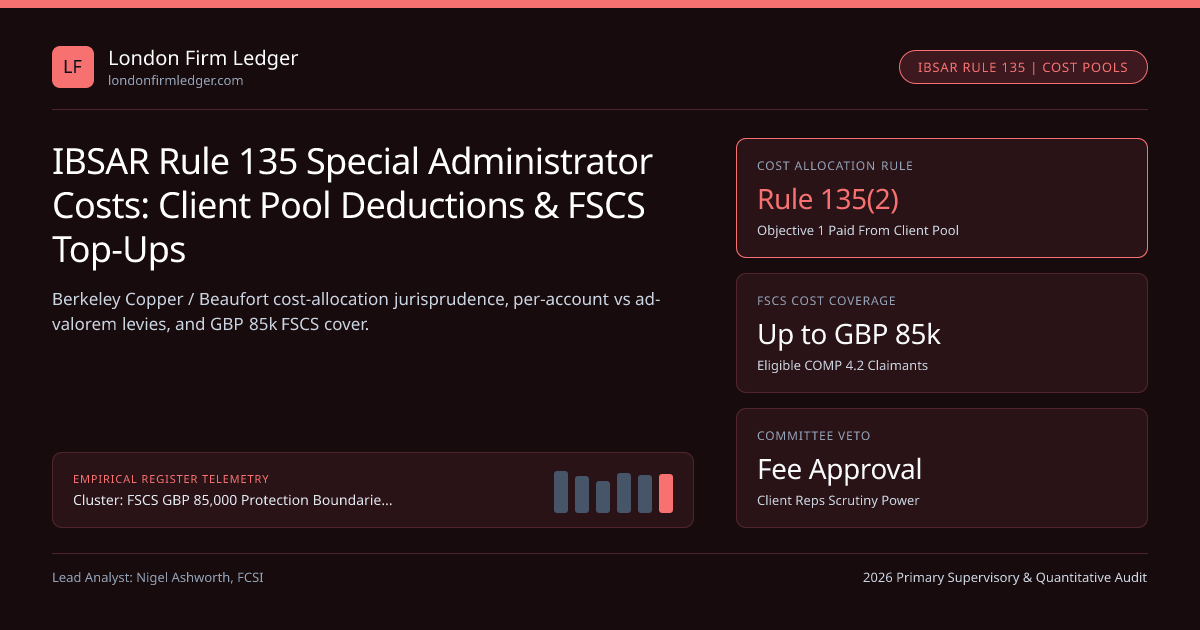
"How can an insolvency practitioner take GBP 140,000 out of my GBP 2,000,000 segregated FTSE 100 equity portfolio when every single share is sitting safely inside my broker's CREST nominee account and zero shares were stolen?" Every UK brokerage failure triggers that exact courtroom confrontation—governed by Rule 135 of the Investment Bank Special Administration (England and Wales) Rules 2011 (SI 2011/1301) and the High Court's equitable jurisdiction originating in Re Berkeley Applegate (Investment Consultants) Ltd [1989] Ch 32.
Within our FSCS, IBSAR & PRA master guide, Rule 135 is the ultimate financial proof of why institutional investors, family offices, and HNW individuals scrutinise a London broker's MIFIDPRU own funds and CASS 10 Resolution Pack hygiene at houses like City Index, Britannia Global Markets, and CFI International even when client assets are 100% segregated!
Dual-Track Expense Split Under IBSAR Rule 135#
Special Administrators must maintain strict time-sheet split accounting from Hour 1 of appointment across two mutually exclusive expense buckets:
| Expense Category | Statutory Bucket (IBSAR Rule 135) | Who Pays the Bill? | Judicial & Regulatory Checks on Fee Inflation |
|---|---|---|---|
| Objective 1 Costs (Reconciling CASS 6/7 ledgers, chasing sub-custodians, operating client portal, drafting Distribution Plan, bulk transfer) | Rule 135(2) Client Asset Expense Pool (allocated across CASS 7 cash & CASS 6 custody) | Deducted directly from Client Money & Custody Assets! (FSCS reimburses up to GBP 85,000 per eligible COMP 4.2 client) | Audited by Client Reps + FSCS on Creditors' Committee (IBSAR Reg 14) + High Court Chancery Judge |
| Objectives 2 & 3 Costs (Selling office leases/IP, pursuing negligent directors, investigating general corporate creditors, tax filings) | Rule 135(1) General Corporate Estate Expense Pool | Paid strictly out of General Corporate Assets (NEVER chargeable to segregated CASS 6/7 client pools!) | Audited by General Creditor Representatives on Creditors' Committee |
| Litigation Over Disputed Proprietary Pool Boundaries (e.g., tracing commingled accounts) | Court-directed hybrid apportionment | Apportioned by High Court Judge according to benefit / Berkeley Applegate equity | Subject to formal High Court costs assessment |
How HNW Investors Avoid Forced Share Liquidation to Pay Rule 135 Fees#
Notice metric 3 in the diagram above (STOCK LIEN POWER): suppose an HNW investor holds GBP 3,000,000 of illiquid AIM equities (ISIN shares on London Stock Exchange AIM) inside an ISA with GBP 0 cash, and the Court-approved Distribution Plan levies a capped GBP 135,000 Rule 135 fee on that account:
- FSCS Contribution: FSCS pays the first GBP 85,000 directly to the Special Administrator.
- Residual Investor Fee Owed:
GBP 135,000 - GBP 85,000 = GBP 50,000. - Crucial Election: Well-drafted IBSAR Distribution Plans (such as Beaufort and WealthTek) give the HNW investor a cash top-up election window—allowing the investor to wire GBP 50,000 fresh cash to the Special Administrator to release 100% of their AIM shares intact into a new ISA manager, rather than letting the Administrator dump illiquid AIM stock into a wide bid-offer spread!
Worked Capped Ad-Valorem vs Uncapped Cost Allocation Model#
Let us compare two High Court Distribution Plan cost-allocation designs recovering GBP 18,000,000 of Objective 1 fees across a failed wealth house holding GBP 300,000,000 in client assets (2,800 retail accounts averaging GBP 50k = GBP 140M + 80 HNW/Corporate accounts averaging GBP 2.0M = GBP 160M):
- Avg Retail Account (GBP 50,000): Levy = GBP 3,000 -> FSCS Pays GBP 3,000 -> Investor Pays GBP 0!
- Avg HNW Account (GBP 2,000,000): Levy = GBP 120,000 -> FSCS Pays GBP 85,000 -> HNW Pays GBP 35,000!
- Avg Corp Account (GBP 2,000,000): Levy = GBP 120,000 -> FSCS Pays GBP 0 -> Corp Pays GBP 120,000!
- Design B — Court-Balanced Hybrid Formula (GBP 1,500 Fixed Per Account + 4.6% Capped at GBP 95,000 Max):
- Fixed Account Revenue (2,880 * GBP 1,500) = GBP 4,320,000 (Reflects uniform KYC/portal cost per client!)
- Avg Retail Account (GBP 50,000): Levy = 1,500 + 2,300 = GBP 3,800 -> FSCS Pays 100% (GBP 0 Client Loss)
- Avg HNW Account (GBP 2,000,000): Capped at GBP 95,000 -> FSCS Pays GBP 85,000 -> HNW Pays GBP 10,000 (-71%!)
- Avg Corp Account (GBP 2,000,000): Capped at GBP 95,000 -> Saves GBP 25,000 vs Uncapped Ad-Valorem!
Comparing Client Out-of-Pocket Rule 135 Burdens by Fee Formula#
The FSCS Anti-Gaming Principle in Chancery Distribution Hearings#
Look closely at step 4 in the chart above: in Re SVS Securities and Re WealthTek, the Financial Services Compensation Scheme appeared by Leading Counsel in the High Court to ensure Special Administrators did not artificially skew costs onto small retail accounts merely because FSCS would pick up the tab (which unfairly taxes healthy UK brokers paying FSCS MELL levies)! Having completed our deep dive into brokerage insolvencies and IBSAR bar dates, we now cross Threadneedle Street to examine how the Prudential Regulation Authority prevents wholesale trading losses from ever touching retail deposits: PRA GBP 35 billion bank ring-fencing rules on our FSCS & PRA Topic Hub.
Frequently asked questions
What is the Re Berkeley Applegate equitable principle behind IBSAR Rule 135?
In Re Berkeley Applegate (Investment Consultants) Ltd [1989] Ch 32, the High Court held that where an insolvent trustee holds trust assets for beneficiaries and its own corporate estate is empty, equity will not let the trust go unadministered—granting the insolvency practitioner an equitable lien over trust property for reasonable skill and expenses spent identifying and returning it.
How did the Beaufort Securities IBSAR collapse illustrate Rule 135 and FSCS collaboration?
When Beaufort Securities entered IBSAR in March 2018 holding ~GBP 550M in client assets across ~16,000 accounts, PwC initially estimated ~GBP 100M in costs before negotiating a settled ~GBP 55.2M fee cap with FSCS and the Creditors Committee—where FSCS funded costs for >99% of retail clients within the GBP 85,000 cap!
Are Objective 1 fees charged purely as a flat percentage of portfolio value or per account?
High Court Distribution Plans customize the formula to reflect fairness! Pure percentage (ad valorem) levies unfairly force a single GBP 20M gilt holder to pay GBP 1M for a simple 1-ISIN CREST transfer; courts frequently approve capped ad-valorem rates (e.g., 0.75%–5% capped at GBP 100k–GBP 250k per account) or per-stock-line charges.
Do corporate own funds left inside a CASS 7.13.41R Prudent Segregation buffer offset Rule 135 costs?
While CASS 7.13.41R Prudent Segregation primarily absorbs CASS 7 client money reconciliation shortfalls during the Primary Pooling Event, clean CASS 10 Resolution Packs and surplus corporate liquidity dramatically shrink Objective 1 forensic hours—directly slashing the Rule 135 bill!
Publication record
- Published
- 13 November 2026
- Updated
- 14 November 2026
- Author
- Nigel Ashworth, FCSI
- Review
- Review not recorded
- Automated fact check
- Passed in the stored pipeline record
- Source URLs
- 4 recorded
AI assistance recorded: anthropic/claude-opus-4.6. This field does not establish human review or source verification.
Academic & Institutional Attribution
Cite This Research & Embed Live Data Card
Standard academic & institutional research paper citation format.
Nigel Ashworth, FCSI. (2026, November 14). IBSAR Rule 135 Special Administrator Costs: Client Pool Deductions & FSCS Top-Ups. London Firm Ledger. https://londonfirmledger.com/gazette/ibsar-administrator-costs-client-asset-pool-deduction-fscs-topupRegulatory Directory Cross-Reference
Referenced Institutions & Regulatory Registries
Mentioned Regulated Institutions
Referenced Supervisory Authorities
Related Fscs Compensation Pra Ring Fencing & Institutional Briefings
Explore Fscs Compensation Pra Ring Fencing Hub (20) →Fscs Compensation Pra Ring Fencing
FSCS GBP 85,000 Protection, IBSAR Special Administration & PRA Ring-Fencing Guide (2026)Fscs Compensation Pra Ring Fencing
PRA Bank Ring-Fencing: Core Deposit Thresholds (GBP 35B) & Excluded ActivitiesFscs Compensation Pra Ring Fencing
PRA Ring-Fenced Body Governance: Board Independence, Intragroup Caps & Arm's-Length RulesFscs Compensation Pra Ring Fencing
PRA Single Customer View (SCV) & Exclusions View: 24-Hour FSCS File Verification RulesFscs Compensation Pra Ring Fencing
Bank of England MREL, Bail-In Resolution & the UK Insolvency Creditor HierarchyFscs Compensation Pra Ring Fencing
PRA SS2/21 Outsourcing & Third-Party Risk: Cloud Concentration, Audit & Step-In RightsFscs Compensation Pra Ring Fencing
PRA PS21/1 & FCA PS21/3 Operational Resilience: Impact Tolerances & Severe ScenariosFscs Compensation Pra Ring Fencing
PRA Basel 3.1 (PS17/23 & PS9/24): UK RWA Output Floor, FRTB & SME Lending RulesCbi Ireland Gibraltar Gfsc Authorisation
Ireland FSPO (Financial Services and Pensions Ombudsman): EUR 500k Awards & Name-and-ShameCbi Ireland Gibraltar Gfsc Authorisation
Gibraltar Financial Services Act 2019 (FSA 2019): Permissions & Regulated Individuals (RIP)Cbi Ireland Gibraltar Gfsc Authorisation
Gibraltar GFSC DLT Providers Regime: All 10 Regulatory Principles & Market IntegrityCbi Ireland Gibraltar Gfsc Authorisation
UK–Gibraltar Authorisation Regime (GAR): Financial Services Act 2021 Schedule 2A Market Access
London Firm Ledger Data, Benchmarks & Contributor Records
CC BY 4.0 Open Data
Open Institutional Datasets (CSV / JSON) →
Download desk-compiled quantitative series & schemas.
2026 Reference Matrix
2026 Institutional Benchmarks & Thresholds →
Statutory capital, clearing, margin & rate conventions.
Editorial Records
Authors & Review Records →
View named contributors where those records are available.
Complete Index
Master Research & Dossier Archive →
Browse all published briefings by topic pillar & date.