
Cbi Ireland Gibraltar Gfsc Authorisation
CBI MiFID II Authorisation (S.I. 375/2017): Substantive Presence, Anti-Letterbox & Outsourcing
Applying to the Central Bank of Ireland for MiFID II authorisation under S.I. 375/2017 requires far more than capital and a Dublin lease: applicants must prove autonomous "heart and mind" governance, independent local risk challenge, and strict controls over back-to-back London hedging.
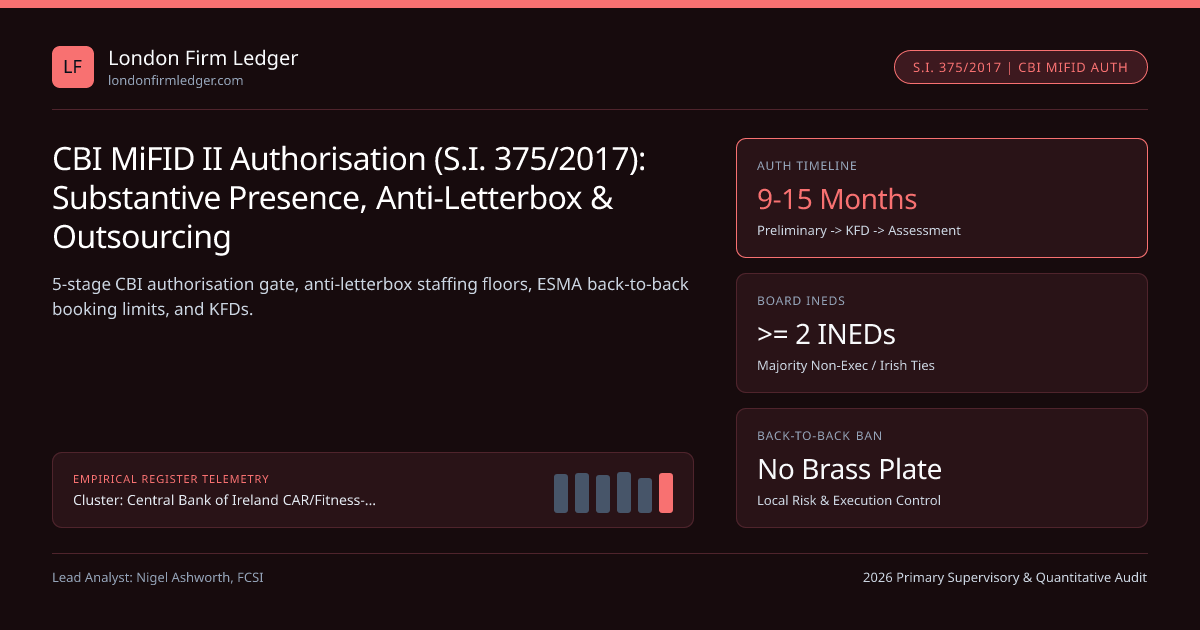
International financial groups expanding beyond their UK FCA Part 4A permission—benchmarking peers such as BUX, Capital.com, B2C2, and Alpha FX—choose Dublin (S.I. No. 375 of 2017) for one strategic prize: an English-speaking common-law MiFID II licence that passports seamlessly into all 27 EU and 3 EEA Member States (Article 34 Freedom to Provide Services & Article 35 Branch Passport).
Yet within our CBI Ireland & Gibraltar GFSC master guide, founders who approach the Central Bank of Ireland expecting to rent three co-working desks on St Stephen's Green while running 95% of trading, compliance, and tech out of London hit an immovable regulatory wall: CBI's Anti-Letterbox Substance Doctrine and December 2021 Cross-Industry Guidance on Outsourcing!
Five-Stage CBI MiFID II Authorisation Pipeline (S.I. 375/2017)#
| Authorisation Stage | Key Deliverable Submitted to CBI | Typical Duration | Primary Reason Applications Stall or Fail |
|---|---|---|---|
| Stage 1: Pre-Application | Request for Preliminary Meeting + Pitch Deck | 4–6 Weeks | Unclear EU target market or unregulated crypto/FX mixed perimeter |
Stage 2: Key Facts Document (KFD) | 25–35 page KFD: Shareholder tree, org chart, booking flows, EU IFR Class 2/3 math | 6–10 Weeks (Iterative CBI feedback) | Fatal Substance Deficit: proposing part-time/fly-in PCFs or 100% unchallenged London back-to-back booking! |
| Stage 3: Formal Submission | Complete MiFID Application Form, Business Plan, ICAAP/ICARA, CAR CMP, PCF IQs (<= 10d completeness check) | 2–4 Weeks | Missing qualifying-shareholder (>=10%) source-of-wealth forensics or incomplete PCF IQs |
| Stage 4: Assessment Phase | Multi-round CBI Regulatory Risk comments + 90-min PCF Gatekeeper Interviews | 5–9 Months | PCF-8 / PCF-12 / PCF-14 candidates failing local Irish rule mastery at PCF IQ interview |
| Stage 5: Minded to Authorise -> Go-Live | Inject paid-up CET1 capital into Irish bank, sign CAFLs, verify live IT | 4–8 Weeks | Delay opening local Irish operational/client bank IBANs! |
Engineering Compliant Dublin–London Back-to-Back Hedging (Anti-Letterbox Rules)#
Can a Dublin CBI subsidiary of a London broker hedge its market risk with its London FCA sister market-maker (e.g., Matched Principal or Back-to-Back OTC Hedge)? Yes—provided you engineer four non-negotiable substance safeguards demanded by ESMA and the CBI:
- Multi-LP Best Execution Optionality: Dublin cannot be hard-coded to route 100% of orders solely to its London affiliate regardless of spread! Dublin must connect to at least one independent external EEA/tier-1 liquidity provider (
Fallback / Price-Benchmark LP) and run independent Dublin TCA proving the London affiliate delivers equal or better pricing! - Hard
K-CON& CollateralisedVM/IMLimits: Dublin treats its London affiliate as a third-country counterparty, enforcing daily Variation Margin settlement so uncollateralised mark-to-market exposure never breaches 25% of Own Funds (EU IFR K-CON)! - Dublin Pre-Trade Kill-Switch Authority: The Dublin
PCF-14CRO and Dublin dealing desk must possess an independent local kill-switch to halt order flow or widen spreads without asking permission from London! - EU DORA (
Reg 2022/2554— Live 17 January 2025!): Any IT trading engine licensed from the London parent is classified as an ICT Intra-Group Third-Party Service Provider supporting Critical or Important Functions under EU DORA, requiring full DORA contractual clauses and Register of Information reporting!
Quantitative Dublin Substance & Intra-Group Cost/Capital Model#
Let us size the minimum realistic Year-1 Fixed Overhead & EU IFR Capital Budget for a newly authorised Dublin Class 2 Retail Multi-Asset MiFID Broker (12 Irish FTEs, CAR client-asset permissions, and EEA Art 34 passporting):
- 1. Local Irish Substance Payroll (12 FTEs — PCF-8 CEO, PCF-11 CFO, PCF-12 Comp, PCF-14 CRO, PCF-45 HoCAO, PCF-52 AML + 6 Ops/Dealing):
- AnnualDublinPayrollAndPRSI = EUR 1,680,000
- 2. Governance & Premises (2x PCF-2B INED Fees EUR 110k + IFSC Office + DORA IT/Audit/CAER + ICCL/CBI Levies):
- AnnualNonStaffFixedOverheads = EUR 760,000
- TotalAuditedFixed_Overheads (FO) = EUR 1,680,000 + EUR 760,000 = EUR 2,440,000 / Year
- 3. Binding EU IFR Own Funds & Liquid Asset Floor at Day-1 Go-Live:
- PermanentMinimumCapital (PMR — Class 2 Non-Own-Account / Client-Asset) = EUR 150,000 (or EUR 750,000 if Dealing on Own Account!)
- FixedOverheadsRequirement (FOR = 25% of Year-1 Projected FO) = 0.25 * EUR 2,440,000 = EUR 610,000
- CBIAuthorisationStressHeadroomBuffer (Typical +50%–100% Runway) -> Paid-Up Day-1 CET1 = EUR 1,500,000 to EUR 2,200,000!
Comparing Brass-Plate Rejection vs Approved Dublin MiFID Substance#
Comparing EU IFR / IFD in Dublin Against UK MIFIDPRU in London#
Notice in step 3 of the formula above (EUR 150k vs EUR 750k PMR and 25% FOR): while EU IFR/IFD (Regulation (EU) 2019/2033) in Dublin and UK IFPR (MIFIDPRU) in London share a common post-2021 K-Factor ancestry, EU IFR retains systemic Class 1 and Class 1-Minus bank-reclassification cliffs (EUR 30B / EUR 15B) that the UK deliberately scrapped! We dissect those exact prudential differences next in CBI EU IFR/IFD Class 1-Minus, Class 2 & Class 3 prudential rules on our CBI Ireland & Gibraltar GFSC Topic Hub.
Frequently asked questions
What is the Key Facts Document (KFD) stage in a Central Bank of Ireland MiFID II application?
Before accepting a 600-page formal MiFID application pack, the CBI requires applicants to submit a concise Key Facts Document (KFD) summarising shareholder ownership, 3-year financial/IFR capital projections, proposed MiFID Schedule 1 services, Irish FTE org chart, intra-group booking flows, and CAR applicability—flushing out fatal substance flaws early!
Can a Dublin MiFID broker hedge 100% of its retail CFD market risk back-to-back with its London FCA sister firm?
Hedging market risk with a well-capitalised London FCA affiliate (such as a group market-maker) is permitted ONLY IF the Dublin entity retains independent credit/concentration limits (K-TCD / K-CON), independent best-execution monitoring showing competitive pricing vs external LPs, and an executable contingency LP if the London affiliate fails!
How many independent Non-Executive Directors (INEDs) does the CBI typically require on a Dublin MiFID board?
For standard Class 2 MiFID firms (especially those holding client assets or serving retail clients across the EEA), the CBI typically expects a minimum 5-person board comprising Executive Directors, Group Non-Executive Director(s), and at least TWO Independent Non-Executive Directors (PCF-2B) bringing Irish regulatory challenge!
What does "Minded to Authorise" mean at Stage 4/5 of a CBI MiFID application?
Before granting live MiFID authorisation on the CBI Register, the CBI issues a "Minded to Authorise" letter listing binding Pre-Authorisation Conditions: injecting paid-up CET1 cash into an Irish bank account, executing final CAFLs, passing final PCF IQ interviews, and demonstrating live IT/safeguarding readiness!
Publication record
- Published
- 13 November 2026
- Updated
- 16 November 2026
- Author
- Nigel Ashworth, FCSI
- Review
- Review not recorded
- Automated fact check
- Passed in the stored pipeline record
- Source URLs
- 4 recorded
AI assistance recorded: anthropic/claude-opus-4.6. This field does not establish human review or source verification.
Academic & Institutional Attribution
Cite This Research & Embed Live Data Card
Standard academic & institutional research paper citation format.
Nigel Ashworth, FCSI. (2026, November 16). CBI MiFID II Authorisation (S.I. 375/2017): Substantive Presence, Anti-Letterbox & Outsourcing. London Firm Ledger. https://londonfirmledger.com/gazette/cbi-mifid-investment-firm-authorisation-substantive-presenceRegulatory Directory Cross-Reference
Referenced Institutions & Regulatory Registries
Mentioned Regulated Institutions
Related Cbi Ireland Gibraltar Gfsc Authorisation & Institutional Briefings
Explore Cbi Ireland Gibraltar Gfsc Authorisation Hub (20) →Cbi Ireland Gibraltar Gfsc Authorisation
Central Bank of Ireland CAR, IAF/SEAR & Gibraltar GFSC UK Market Access Guide (2026)Cbi Ireland Gibraltar Gfsc Authorisation
CBI EU IFR & IFD Prudential Tiers: Class 1, Class 1-Minus, Class 2 & Class 3 vs UK IFPRCbi Ireland Gibraltar Gfsc Authorisation
CBI Payment & E-Money Safeguarding: Dear CEO Audits, S.I. 48/2018 & PSD3 ReadinessCbi Ireland Gibraltar Gfsc Authorisation
Ireland FSPO (Financial Services and Pensions Ombudsman): EUR 500k Awards & Name-and-ShameCbi Ireland Gibraltar Gfsc Authorisation
Gibraltar Financial Services Act 2019 (FSA 2019): Permissions & Regulated Individuals (RIP)Cbi Ireland Gibraltar Gfsc Authorisation
Gibraltar GFSC DLT Providers Regime: All 10 Regulatory Principles & Market IntegrityCbi Ireland Gibraltar Gfsc Authorisation
UK–Gibraltar Authorisation Regime (GAR): Financial Services Act 2021 Schedule 2A Market AccessCbi Ireland Gibraltar Gfsc Authorisation
Gibraltar Deposit Guarantee (GDGS), Investor Compensation (GICS) & UK FSCS GAR ParityEconomic Trends
Young people in UK hit by ‘low-gear economy’, warns Bank of England deputy - The GuardianMarket Insights
This oversold FTSE 100 growth stock is tipped to rise 42% in a year! Here’s what I think - Yahoo Finance UKRegulatory Compliance
Tokenised collateral: Bank of England sets out approach for central clearing - Lewis SilkinMarket Insights
HSBC to open new London HQ in March or April 2027 - Reuters
London Firm Ledger Data, Benchmarks & Contributor Records
CC BY 4.0 Open Data
Open Institutional Datasets (CSV / JSON) →
Download desk-compiled quantitative series & schemas.
2026 Reference Matrix
2026 Institutional Benchmarks & Thresholds →
Statutory capital, clearing, margin & rate conventions.
Editorial Records
Authors & Review Records →
View named contributors where those records are available.
Complete Index
Master Research & Dossier Archive →
Browse all published briefings by topic pillar & date.